
Solar Energy Systems for Farms in Michigan
Agricultural solar built around what your operation actually runs.
Michigan farms run on electricity that costs more every year, from grain dryers and irrigation pumps to milking parlors and cold storage. Solar turns one of your few controllable operating costs into equipment you own, sized to what your operation actually consumes. Our Michigan based team handles the entire project from design to activation.
80+ Reviews
Pearl Certified & Michigan Saves Authorized
Award Winning Solar Installer

Electricity is One of the Few Farm Costs You Can Actually Fix
Seed, fuel, fertilizer, feed, labor. Almost every input on a Michigan farm is priced by somebody else, and the number moves whether you like it or not. Power is the one line on the operating statement where you have another option, because you already own the roofs, the outbuildings, and usually a few acres that have never paid their way.
Solar panels for farms turn a recurring operating expense into a fixed asset you own. Instead of paying DTE Energy or Consumers Energy for every kilowatt hour your dryers, pumps, and coolers consume, you generate a share of it on site. The equipment sits on your property, depreciates on your books, and keeps producing long after the payback period closes.
Strawberry Solar has designed and installed systems across the Lower Peninsula since 2010, including several agricultural projects. Our team handles the design, the permits, the utility interconnection, and the installation, then stays on for monitoring and service.
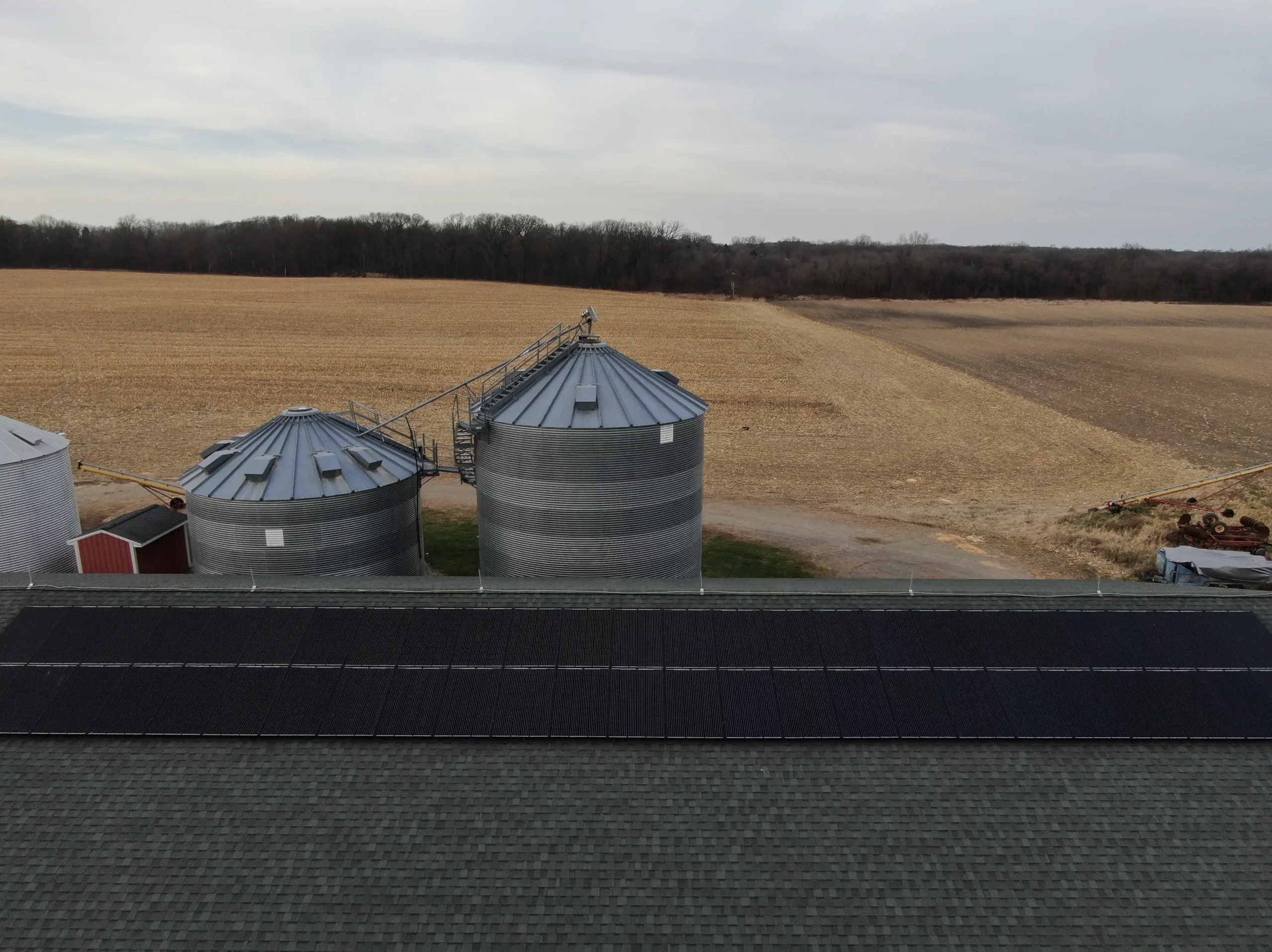
On-Farm Solar Is Not the Same as Leasing Land to a Developer
If a company has contacted you about putting solar on your acreage, that is a different proposition from what is described here. Both get called farm solar, and they lead to completely different outcomes.
Leasing land
A Developer Owns the Array
You sign a long term lease or easement, a solar company builds a utility scale project on your ground, and the power goes onto the grid rather than into your operation. You receive lease income. Your own electric bill does not change. If the ground is enrolled in PA 116, the agreement has to be amended through MDARD before anything gets built.
On-farm solar
You Own the Array
The system is sized to your consumption and connected behind your meter, so the power offsets what you would otherwise buy. It goes on a barn roof, a shop roof, or a ground mount near your service. You own the equipment, you claim the depreciation, and the savings show up on the bill every month.
Strawberry Solar designs and installs owned systems. Every array we build is sized to a working operation, connected behind that operation’s meter, and owned by the farm it serves.
What It powers
What Solar Panels for Farms Can Run on a Michigan Operation
A farm is not one building with one load. It is a collection of loads that peak at different times of year, which is exactly why farm solar has to be designed rather than ordered off a shelf. These are the demands our system designs are built around.
Grain Drying & Aeration
Short, intense, and expensive. Dryer and fan loads concentrate into a few weeks of fall, which shapes how a system is sized and whether storage makes sense alongside it.
Irrigation & Well Pumps
Summer pumping lines up well with peak solar production. Pivot motors, transfer pumps, and well pumps are among the most predictable loads to offset on a Michigan farm.
Milking & Bulk Tank Cooling
Vacuum pumps, plate coolers, compressors, and water heating run every single day. Dairy operations carry some of the steadiest year round demand of any farm type.
Livestock Ventilation & Heat
Barn fans, curtain motors, and brooder heat run on a schedule the weather sets. Ventilation is also the load where an outage does the most damage the fastest.
Cold & Controlled Atmosphere Storage
Apple, cherry, and produce storage runs compressors for months after harvest. Long duration, high consistency demand is a strong candidate for offset.
Shop, Compressors, & Equipment
Welders, air compressors, lifts, lighting, and the farm office add up quietly across the year and are easy to underestimate when sizing a system.
Load Shape Matters More Than Roof Space
Plenty of installers will look at a barn, measure the roof, and quote whatever fits. That approach produces a system sized to your architecture instead of your operation. A farm that dries corn for three weeks and idles most of the winter needs a different design than a dairy pulling steady load every day of the year.
Our team starts with your consumption history across every metered structure on the property, then models production against it. Under Michigan’s distributed generation rules, electricity you use on site as it is produced is worth more to you than electricity you export, so matching production to your actual demand curve directly affects what the system returns.
Where continuous loads make an outage genuinely costly, we look at whether solar battery storage belongs in the design alongside the array.
Mounting
Where Farm Solar Panels Get Installed
Most Michigan farms have more than one workable surface. Choosing between them comes down to roof condition, structure, shading, and how close each option sits to your service entrance.
Pole Barn and Metal Roofs
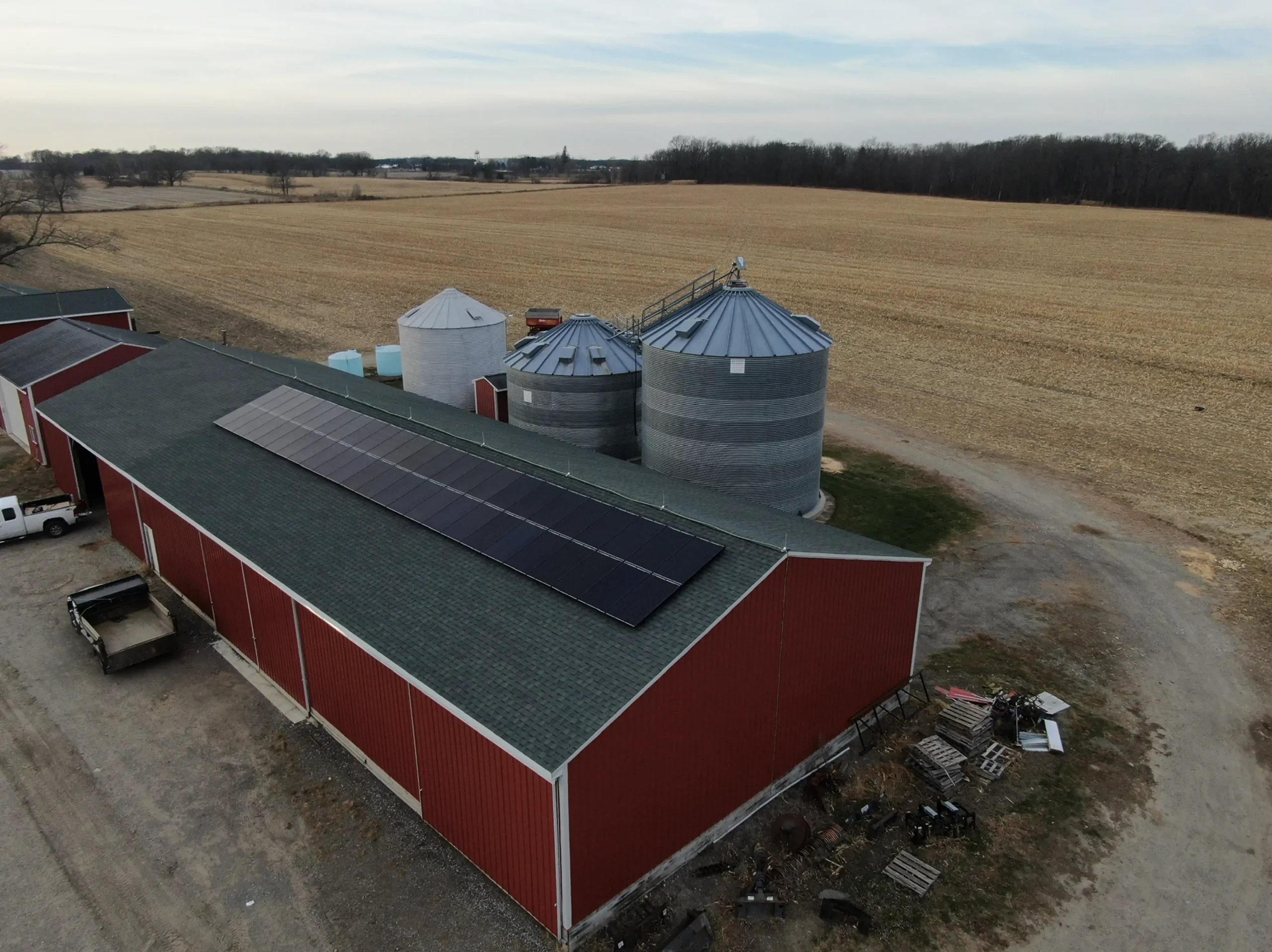
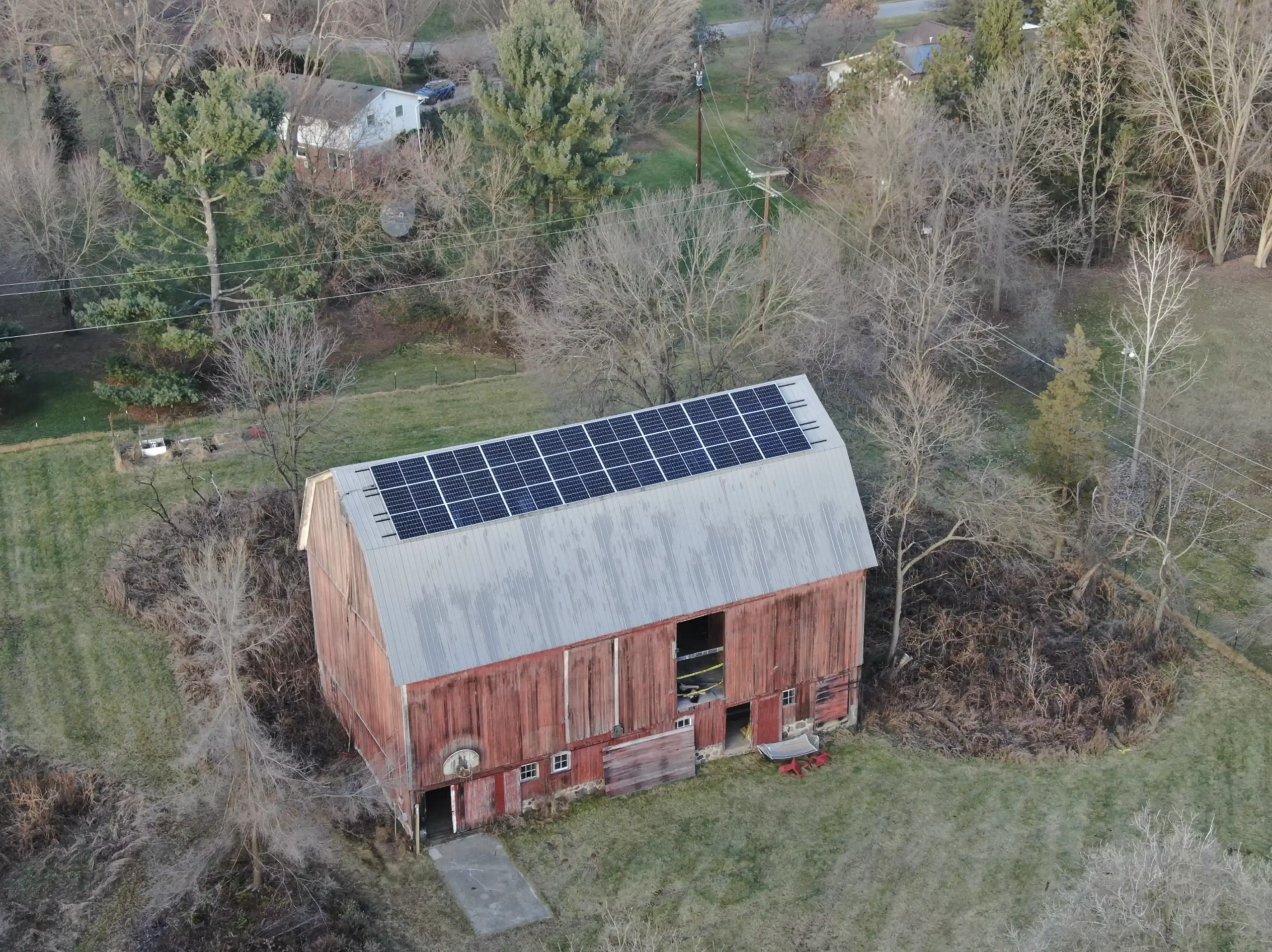
Standing seam metal roof solar installation is often the best surface on the property. Clamp mounted racking attaches without penetrating the roof, and these buildings tend to be newer, larger, and less shaded than the house. Residential pole barns are similar, but often smaller scale than agricultural solar installs.
Shop, Shed, and Existing Barn Roofs
Older barns can absolutely carry an array, but structure and roof age get evaluated first. If a roof is near the end of its life, replacing it before installation is cheaper than pulling panels off later.
Ground Mount on Marginal Acreage
Fence rows, wet corners, odd angles, and ground that has never yielded well. Ground mounts allow ideal tilt and orientation, and they keep equipment accessible for service without a lift.
Let’s Look at What Your Farm Actually Uses
Send us recent electricity bills and we will model what a system on your property would produce against your real consumption. No cost, no obligation.
Get a Free Solar Assessment →Michigan Rules
How Michigan’s Distributed Generation Rules Changed Farm-Scale Solar
This is the part national solar companies get wrong about Michigan, and it matters more for farms than for almost any other customer.
For years, Michigan’s distributed generation program capped a customer’s renewable energy system at 150 kilowatts. That ceiling was fine for a house and workable for a small storefront. For a farm, it was a real constraint. Plenty of grain, dairy, and storage operations consume well past what 150 kilowatts of solar can offset, which meant the system you were allowed to build and the system your operation actually needed were two different things. Methane digesters were the one exception, already permitted up to 550 kilowatts, so the state understood farm-scale generation long before it extended the same allowance to solar.
Public Act 235 of 2023 fixed both of the limits that were holding farm projects back. Solar systems can now participate at up to 550 kilowatts, the same ceiling digesters already had. Separately, the sizing rule moved from 100 percent of your previous twelve months of consumption to 110 percent, so a system can be built with some headroom for growth rather than strictly against past usage. Both rules apply together. The 550 kilowatt cap is the ceiling, and 110 percent of your consumption is the sizing basis.
The program itself also got much larger. The overall cap rose from 1 percent to 10 percent of a utility’s average in-state peak load over the preceding five years. Under the old allocation, no more than a quarter of one percent of that load was available to systems between 20 and 150 kilowatts. Up to 5 percent is now available to systems between 20 and 550 kilowatts, roughly twenty times the room farm-scale projects had before.
What This Means for Your Design
- Your system can be sized up to 110 percent of your last twelve months of consumption, within the 550 kilowatt ceiling
- Up to half the program is available to systems between 20 and 550 kilowatts, roughly twenty times the room that band had under the old rules
- Compensation still favors on-site consumption over export, so design and load matching drive the return
- DTE Energy and Consumers Energy administer their own tariffs and application processes, and the details differ by territory
- Strawberry Solar files the interconnection application and manages the utility process on your behalf
Permit requirements vary from township to township across rural Michigan, and some jurisdictions handle very few solar applications a year. Our team handles the full permitting process, including the ones where we are the first solar project the office has reviewed.
For the wider incentive picture beyond agriculture, see our Michigan solar incentives breakdown.
Financing
Paying for Agricultural Solar
The funding landscape for farm solar shifted substantially over the past year, and a lot of what is published online has not caught up. Here is where each piece stands.
Where USDA REAP Actually Stands
The Rural Energy for America Program has been the single largest funding source for on-farm solar, and most solar company websites still advertise REAP grants covering up to half a project’s cost. That is not the current situation.
USDA is not accepting REAP grant applications right now. The agency is rewriting the program regulations, and no further grant awards are being made until those regulations take effect. A new funding notice will publish once they do, and applicants who previously submitted will have the opportunity to reapply under the new requirements.
REAP guaranteed loans are a different matter. Those applications are still being accepted, and the loan side of the program remains an active financing option for farm solar today.
Strawberry Solar assists with REAP paperwork. That means helping you assemble what the program requires now for the loan guarantee, and having your project documented and ready if you want to be positioned when the grant window reopens. What we will not do is tell you a grant is coming when USDA has not said so.
One Eligibility Rule Worth Knowing
A common assumption is that a farm close to a metro area cannot qualify. For agricultural producers, that is not how the rule reads. Rural small businesses do have to be located in an eligible rural area, but agricultural producers may submit projects located outside rural areas as long as the project is tied to an on-site production operation. Farms in Washtenaw, Oakland, Macomb, and Livingston counties frequently rule themselves out for no reason.
The Federal Credit Is Still Available, and It Now Has a Hard Finish Line
There is a lot of confusion about this one, partly because a widely reported deadline passed in the summer of 2026. That date did not end the commercial solar credit. It ended a longer grace period.
Here is the distinction. Projects that had already begun construction by July 4, 2026 locked in a multi-year window to finish. Projects starting after that date did not lose the credit. They inherited a different rule: the system has to be placed in service by December 31, 2027. For commercial solar under one megawatt, which covers effectively every on-farm system, the credit remains at 30 percent of eligible project cost.
So a farm starting a project today is not too late. What changed is that the clock is now tied to finishing rather than starting, and finishing means approval to operate from your utility, not the day the crew leaves. Between design, permitting, interconnection review, installation, inspection, and final utility sign-off, that sequence takes longer than most people expect. Farms that wait until late 2027 to start the conversation are the ones who will run out of runway.
None of this is tax advice, and the federal rules around equipment sourcing and eligibility continue to develop. Bring your accountant into the conversation early.
Accepting
REAP Guaranteed Loans
Loan guarantees cover up to 75 percent of total eligible project costs. Applications are accepted year round through your state Rural Development office.
Paused
REAP Grants
Not accepting applications while regulations are rewritten. Historically ran from a $2,500 minimum to a $1 million maximum, at either a 25 or 50 percent federal share depending on the project category.
Deadline
Federal Commercial Solar Credit
Still available at 30 percent for farm systems under one megawatt. The array has to be placed in service by December 31, 2027, so your completion date is what governs. Confirm with your tax advisor.
Available
Depreciation
Solar equipment is depreciable business property under MACRS. For most farm operations this is a meaningful share of the total tax benefit, independent of any grant.
Available
Ag Lender Financing
Many operations finance solar through the farm credit relationship they already have. We provide the documentation your lender needs to evaluate the project.
Ongoing
Distributed Generation Credits
Power you export is credited by your utility under Michigan’s distributed generation program. Power you consume as it is produced is worth more, which is why sizing matters.
Process
Our Turnkey Approach to Farm Solar
No two farms present the same electrical picture. Some have one service feeding everything. Others have separate meters on the barn, the shop, the dryer, and the house, added over decades as the operation grew. Three phase service, aging service entrances, and outbuildings spread across a half mile are all normal. Designing around whatever is actually there is the job.
1
Site Visit and Load Review
We walk the property, look at every metered structure, review twelve months of billing, and identify which surfaces and ground are genuinely workable.
2
System Design and Production Modeling
Manufacturer-agnostic design. Equipment gets selected for your conditions and loads rather than because of a supplier relationship, and production is modeled against your consumption.
3
Permitting and Interconnection
We file with your township or county and submit the interconnection application to DTE Energy or Consumers Energy. You do not chase paperwork.
4
Installation Around Your Season
Scheduling works around planting, harvest, and whatever else the calendar dictates. The solar installation process runs from a few days for smaller systems to a few weeks for larger arrays.
5
Commissioning and Monitoring
Final inspection, utility approval to operate, and monitoring set up so you can see production from your phone.
6
Service and Support
Ongoing solar service and maintenance from the same team that built the system, covering monitoring, troubleshooting, and repair. Nobody is diagnosing an array they have never seen.
Why Michigan Farms Choose Strawberry Solar
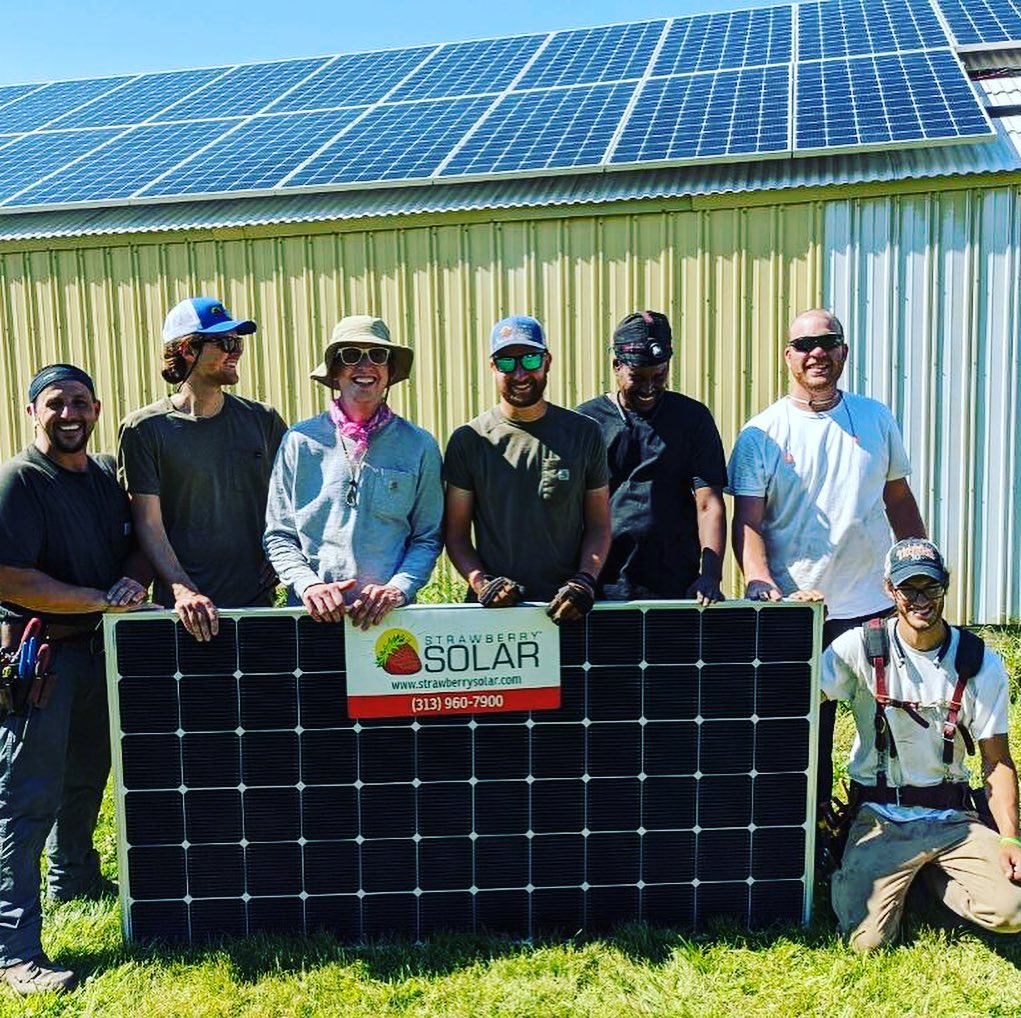
Local Michigan team since 2010. Detroit based, 15 plus years of experience, deep knowledge of DTE and Consumers territory.
Pearl Certified and Michigan Saves authorized. Credentialed and trusted for quality workmanship.
Manufacturer agnostic. We recommend the best fit equipment for your operation, not whatever we are told to sell.
Full turnkey service. Design, permitting, installation, interconnection, monitoring, and support under one roof.
A long term partner. Ongoing monitoring and support for decades, not just through installation day.
We only work with brands we trust and would install on our own homes. We do this to ensure that every customer is satisfied with their solar setup.









Start Earlier Than You Think You Need To
Design, permitting, interconnection review, installation, and final utility approval all sit between your first call and a system that produces power. If the federal credit is part of your math, the array has to be operating by the end of 2027, and that runway is shorter than it sounds.
or call
Farm Solar Questions Michigan Growers Ask
Not at the moment. USDA is not accepting REAP grant applications while the program regulations are being rewritten, and no new grant awards are being made until that work is finished. A new funding notice will publish afterward, and previous applicants will be able to reapply. REAP guaranteed loan applications are still being accepted in the meantime, and we can help you prepare either way.
Rural small businesses do, but agricultural producers do not. If you are directly engaged in agricultural production and the project is tied to an on-site production operation, the project can be located outside a designated rural area. Farms near metro Detroit and Ann Arbor often assume they are ineligible when they are not.
Probably not. A deadline in mid 2026 applied to projects that had already begun construction and gave them extra years to finish. Projects starting after it still qualify for the credit, but they have to be placed in service by December 31, 2027. Placed in service means your utility has granted approval to operate, so the timeline that matters runs from your first call through final inspection. Talk to your accountant about your specific situation.
On standing seam metal, racking clamps to the seams without penetrating the roof at all. On other roof types we evaluate structure and remaining roof life before quoting. If a roof is near replacement, doing that work first is far less expensive than removing and reinstalling an array later.
MDARD has a defined process for allowing commercial solar development on enrolled land, which generally involves amending the agreement and deferring the tax benefit for the duration. That process is aimed at commercial arrays, and most on-farm systems are sited on rooftops or on ground outside the enrolled parcel. If your situation involves enrolled acreage, we will flag it during the site visit so you can confirm the details with MDARD.
It depends on consumption, not acreage. We start from twelve months of utility bills across every meter on the property. Michigan’s rules let you size a system up to 110 percent of that consumption, with a hard ceiling of 550 kilowatts for distributed generation participation. For most operations the constraint is your load rather than the ceiling.
Not on its own. A standard grid-tied array shuts down during an outage for line worker safety. If you need power through an outage, particularly for ventilation or cooling, that requires battery storage designed into the system.
Drying is a short, heavy load concentrated in fall, and it is unlikely to be fully offset in the moment it happens. What solar does is offset your total annual consumption, with credits from higher production months applying against heavier ones. We model this specifically rather than estimating it.
We do. That covers the township or county permit and the interconnection application with DTE Energy or Consumers Energy, through to approval to operate.