
Michigan Off-Grid Solar Installer
Whole-Property Off-Grid Systems
Off-Grid Solar Design & Installation in Michigan
Whole-property systems designed for a Michigan winter, installed by the same team that designs the system and pulls your permits. When there is no utility line at the road, or the quote to run one costs more than the power is worth, an off-grid system lets your property generate and store everything it needs on its own.
Since 2010, Strawberry Solar has designed and installed complete systems across Michigan’s Lower Peninsula for whole homes, homesteads, and properties with several buildings running off one service.
We are an award winning Michigan solar installation company.


Off-Grid Solar for Whole Michigan Properties
Going off grid means your property makes and stores all of its own power. No meter, no monthly bill from DTE Energy or Consumers Energy, and no waiting on a line crew after an ice storm rolls through. For a lot of rural Michigan properties it is the most practical way to get dependable power, and on some parcels it is the only way to get power at all.
Our team designs and installs off-grid systems across Michigan’s Lower Peninsula for homes, homesteads, farm properties, shops, and outbuildings that all run off one service. The choice between a grid-tied system and a true off-grid one usually comes down to what your utility would charge to run service out to the property, and whether that number is larger than building your own.
Pearl Certified installer
Authorized Michigan Saves contractor
Installing solar since 2010
Silver Sol-Ark installer
The Projects We Take On
We build off-grid systems sized to power an entire property, from a single home up through sites with several buildings. We do not take on RV, van, trailer, or portable projects. If that is what you are looking for, a mobile specialist will serve you better, and we would rather tell you that up front.
We only work with brands we trust and would install on our own homes. We do this to ensure that every customer is satisfied with their solar setup.


Why the Design Matters
Why the Design Matters So Much Off Grid
On a grid-tied system, the utility quietly covers whatever your panels do not produce. You see the difference on a bill and the lights never flicker.
An off-grid system does not have that cushion. Your array and your battery bank are the entire supply, so the design has to hold up during the worst week of the year rather than an average one. Michigan makes that a genuine exercise. A December day produces much less than the same array delivers in June, so we size the system against winter first and then confirm it performs comfortably the rest of the year.
Get this part right and the system runs quietly in the background. That is the whole goal, and it is why we spend real time here before anyone orders equipment.
What Every Off-Grid System We Build Includes
›
A design built for winter. Sized for December first, then checked against the rest of the year.
›
Solar array. Roof or ground mount, engineered for Michigan snow and wind.
›
Battery bank. Sited and enclosed so it performs through the winter.
›
Inverter and charge control. Plus the disconnects and protection the code calls for.
›
Generator integration. Set up to run only when the batteries need it.
›
Permits through monitoring. We handle the paperwork, inspections, startup, and monitoring.
Is Off-Grid Right for You?
When Off-Grid Makes Sense in Michigan
Off-grid works beautifully on the right property. These are the situations where it tends to make the most sense.
The Line Extension Quote Is the Problem
Bringing new service out to a remote parcel means poles, wire, clearing, and easements, and the cost climbs with every foot of distance. DTE Energy, for example, installs new residential service connections underground at the customer’s expense. Building generation on site is often the less expensive route, and you own it outright at the end of it.
There Is No Service at the Property
New builds on undeveloped land, back-lot acreage, and hunting property. When the nearest line is a long way off, an off-grid system is the only way the property gets power at all.
An Outage Costs You Real Money
Well pumps, freezers, livestock water, and heat. On a working property, losing power for two days is not a matter of comfort, so having a supply you control is worth planning around.
You Want to Be Done With the Utility
No monthly bill, no rate increases to plan around, and no phone call or report through an app to make when the rest of the neighborhood goes dark.
Already have utility service at the property?
It is worth looking at a residential solar installation with battery storage alongside a full off-grid build. You still get power through an outage, usually at a lower cost, and the grid stays there for the long gray stretches Michigan is known for. We put both options in front of you during the design so you can compare them with real numbers instead of guessing.
Not Sure Which Way Your Property Should Go?
Tell us about the property and what you need it to run. We will lay out what an off-grid build takes and, if utility service is an option, how it compares. No cost, no pressure.
or call
Where Every Off-Grid Project Starts
Off-Grid System Design
Every design follows the same six steps, and each one is built around sizing for a Michigan winter.
Step 1
Load Analysis
We start by mapping every electrical load on the property and what each one actually uses over the course of a day. Heating gets extra attention. Electric resistance heat can make an off-grid system much larger on its own, which is why heating with propane or wood and letting the solar handle everything else usually makes more sense.
Step 2
Peak and Surge Demand
Well pumps, compressors, and shop equipment draw far more power starting up than they do running. Your inverter has to carry those surges, not just the daily average, so we size it for the moment the pump and the freezer kick on together.
Step 3
Array Sizing for a Michigan Winter
We size the array against your lowest-production stretch of the year and account for the losses that come with it: snow cover, panel orientation, tree shading, and a low winter sun angle. Ground mounts often work better than roof mounts on off-grid properties, since you can set a steeper winter pitch and still reach the panels to clear them.
Step 4
Battery Bank and Days of Autonomy
How many cloudy days in a row does your property need to ride out on its own? That answer drives the size of the bank, along with the battery chemistry and how deeply it can be discharged without shortening its life. This is the largest single investment in the system, so we take the time to get it sized properly.
Step 5
Generator Integration
A generator is part of most off-grid designs in Michigan, and that is by design rather than a shortcut. A battery bank large enough to cover a two-week January overcast with no help at all costs considerably more than a generator does. We decide how it ties in and what starts it, so it runs a handful of times a year instead of all winter. This is a different setup from a portable solar generator, which is built to run a few circuits for a few hours.
Step 6
Equipment Specification and Documentation
You end up with the inverter, charge control, disconnects, conductor sizing, and a one-line diagram. That same package is what your building department wants to see, so having it right the first time keeps the approval moving.
You Can Start With Just the Design
A lot of people come to us with a parcel, an idea, and no timeline yet. That is a good place to start, and we are glad to work with you there.
A design gives you a real number to plan around. It tells you whether the property can support what you have in mind before you close on land, pour a foundation, or commit to an all-electric build the site cannot carry. It also gives you something concrete to hold up next to your utility’s line extension quote, which is usually the comparison that settles the question one way or the other.
You are welcome to take the design and sit with it for a while. There is no obligation to install with us.
Get My Free Solar Assessment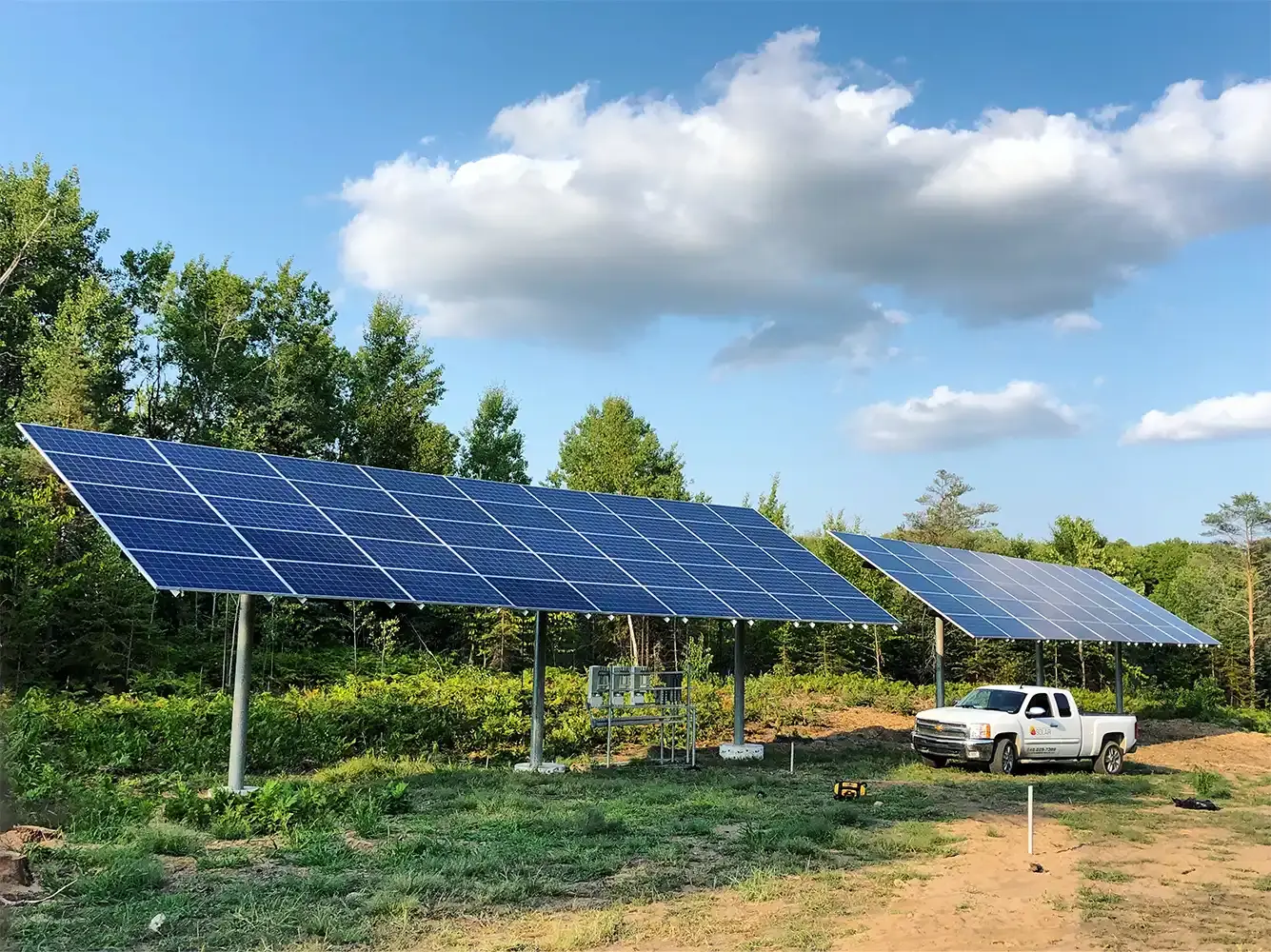
Construction & Install
Off-Grid Solar Installation
Once the design is settled, our crews handle the build from the ground up. Here is what that covers.
1
Array Construction
Roof mount or ground mount, engineered for Michigan snow and wind loads. Ground mounts are common on off-grid sites because you can set a steeper winter pitch and still get to the panels when you need to clear them.
2
Battery Bank and Enclosure
Where the bank lives matters more than most people expect. Batteries hold their capacity within a certain temperature range, and an unheated pole barn in January sits outside it. We site and enclose the bank so it performs through the winter.
3
Inverter, Charge Control, and Protection
The electrical heart of the system, along with the disconnects, overcurrent protection, and grounding that the code calls for and your inspector will check.
4
Commissioning and Monitoring
We bring the system online, confirm it performs the way it was designed to, walk you through running it, and set up monitoring so you can check on it any time.
Permits and Inspections Still Apply
Going off grid does not mean skipping the permit process in Michigan. Electrical work on a dwelling requires a permit whether the power comes from a utility or from your own array, and off-grid solar follows the same electrical code rules as any other solar system, plus the requirements for battery storage.
Requirements vary by township and county, and battery-based systems come across an inspector’s desk less often than standard grid-tied arrays, so a complete and correctly drawn plan set keeps things moving. We take care of all of it. The documentation, the applications, and the inspections are the same installation process we follow on every project, and that side of it belongs to us rather than you.
Septic, well, and zoning approvals come from your county and township, and they’re usually what decides whether living off grid in Michigan works on a particular parcel.
How Long It Takes
Installation runs from a few days on smaller systems to a few weeks on larger arrays and properties with several buildings. Permit review and inspection scheduling sit on top of that and vary by municipality. We give you a realistic window at the start so you can plan the rest of your project around it.
Manufacturer Agnostic
The Equipment in an Off-Grid System
We specify equipment around your loads, your site, and how the system needs to behave in a Michigan winter. Every off-grid system comes down to four pieces working together.
›
Off-grid and hybrid inverters. Your inverter turns stored DC power into the AC your property runs on, carries surge loads, and manages the handoff to the generator. Off-grid duty asks more of an inverter than grid-tied duty does, so we select with that in mind.
›
Charge control and system management. This keeps the batteries charging efficiently, protects them from overcharge and deep discharge, and coordinates the array, the bank, and the generator so the system runs without you supervising it.
›
Battery bank. Capacity, chemistry, and cold-weather behavior are what matter here. Different chemistries handle deep discharge and low temperatures differently, and that difference shows up in both your winter performance and how long the bank lasts.
›
Monitoring. An array, a battery bank, a generator, and controls managing all three add up to a solar microgrid. Monitoring is how you watch it work. Production, consumption, and state of charge are all visible, so you notice something developing well before it becomes a problem.
Silver Sol-Ark Installer
Sol-Ark
All-in-one inverters built for off-grid properties, with generator integration that can start and stop the generator for you.
EG4
Inverters and batteries that can run a property entirely off grid, with room to add more as the property grows.

FranklinWH
A whole-home battery system with generator support that is designed to run off grid. We are a certified FranklinWH installer.
Plan for growth while the design is still on paper
It is also worth planning for growth while the design is still on paper. Arrays and battery banks can be sized with room for a shop, a well, an EV charger, or a load you have not thought of yet. Building that headroom in at the design stage costs very little. Adding it later to a bank built at the bare minimum costs quite a bit more.
Every Off-Grid Project Starts With the Numbers
Send us the property details and what you need it to power. We will show you what it takes to run it independently.
Get a FREE Quoteor call (313) 960-7900
Lifetime Care
Ongoing Solar System Support, Service, and Lifetime Care
An off-grid system is the only power source your property has, which makes long term service a different proposition than it is on a grid-tied home. Batteries have a service life shorter than the panels around them, generators need regular maintenance, and loads change as a property grows. Our field teams keep all of it running, monitor performance year round, and handle the component replacements that come with owning a system nobody else is standing behind.
Solar Panel Expansions
An off-grid system can scale as the property does, provided the original design left room for it. Power needs rarely stay static over a 25 year timeline, and adding a shop, a well, or an EV charger puts real demand on an array and battery bank that were sized for the old load. We handle capacity upgrades and system modifications on systems we built and on systems we did not.
Common reasons many choose to expand their system:
A need for more power (kids, EV, etc.).
Want to upgrade to newer technology.
Want more battery so the bank holds through longer cloudy stretches.
Expand Your SystemDiagnostics and Performance Audits
On an off-grid property, a drop in production is not something you notice on a bill. It shows up as a battery bank that will not hold through the night, or a generator running far more often than it should. If your system is underperforming, throwing monitoring alerts, or was built by an installer who no longer services Michigan, field diagnostics will find what changed.
Common reasons most get a diagnostic with us:
To make sure your system is operating efficiently.
To figure out what components are bad.
To get back to peak performance.
You inherited a solar system and want to know what’s going on.
Get a DiagnosticFinancing
Financing Available Through Michigan Saves
We are an authorized contractor in the Michigan Saves program.
Michigan Saves is a nonprofit green bank that makes clean energy financing accessible to Michigan residents. It operates as a financial program that connects homeowners with authorized lenders.
The program helps Michigan families reduce costs by financing various energy improvements, including renewable energy sources like solar panel installations.
You’ll need our contractor ID to fully apply. If you’ve decided on Michigan Saves or if you have any questions about the program, please reach out and we would be happy to assist!
Request a Quote
Get Started
Why Michigan Property Owners Choose Strawberry Solar
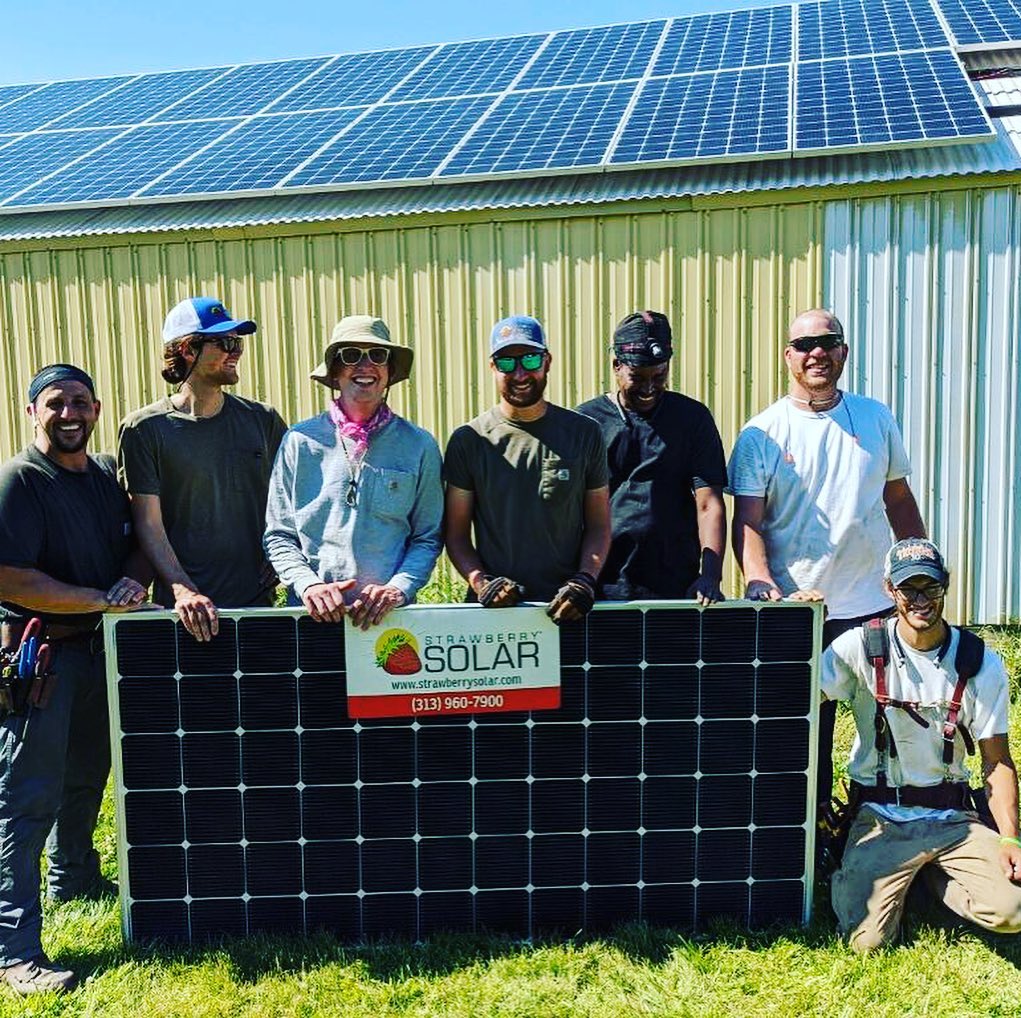
Local Michigan team since 2010. Detroit based, with over fifteen years of installations across the Lower Peninsula and enough winters behind us to know what a December here actually produces.
Credentialed. Pearl Certified, Michigan Saves authorized, and a Silver-tier Sol-Ark installer. Trusted for quality workmanship.
Manufacturer agnostic. We specify the inverter, batteries, and charge control that fit your loads and your site, not whatever we are told to move.
Full turnkey service. Design, permitting, installation, commissioning, monitoring, and support under one roof.
A long term partner. Ongoing monitoring and support for decades, not just through installation day.
Ten-year workmanship warranty. Our warranty on the installation, alongside each manufacturer’s own equipment warranty.
Let’s Get Your Property Running on Its Own Power
Tell us about the property and what you need it to run. We will size the system, pull the permits, build it, and stay with you long after it starts producing.
or call