
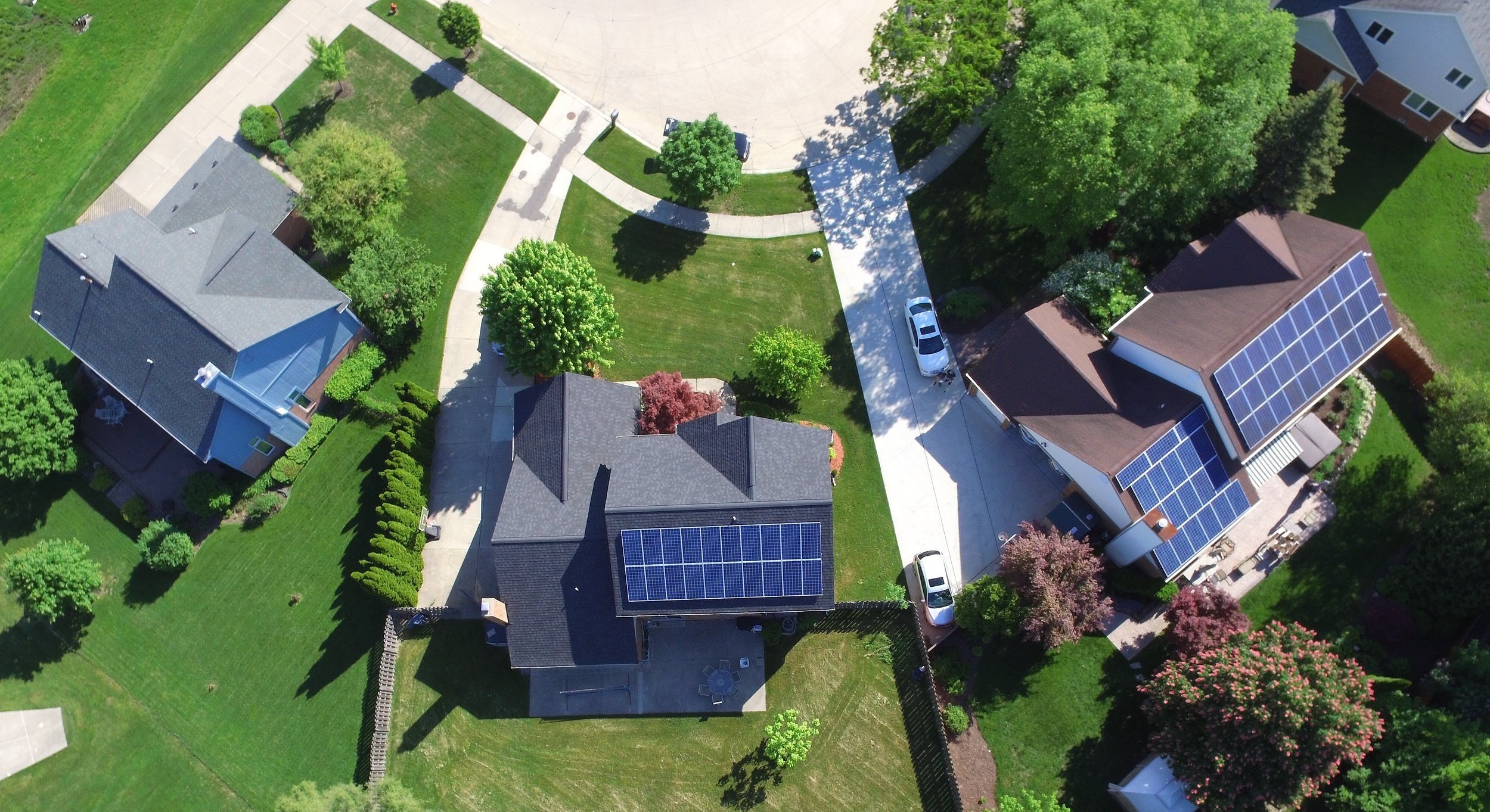

Most people who ask us this question already have a parcel in mind. Sometimes it is forty acres up north. More often lately it is a back lot outside Ann Arbor or a few acres at the edge of a township in Kent County where the nearest utility pole is a long way from where the house would go.
The short answer is yes – off-grid living is legal in Michigan. The power side of it is the routine part. Off-grid electricity is entirely legal statewide, no state law requires a home to have electricity, and a solar permit is ordinary paperwork that gets pulled every day. What decides whether your specific property works is almost always something else: whether your county health department will approve a wastewater system on that soil, and what your township’s zoning ordinance says about the building you want to put there.
A property can be perfectly legal to live on off grid and still be one the health department will not permit. The law is statewide and it’s handled parcel by parcel.
Key Points
- Off-grid living is legal throughout Michigan, and there is no single off-grid law to comply with.
- No Michigan law requires a home to have electricity, and off-grid electricity is legal statewide.
- Electrical permits still apply to off-grid systems, and with few exceptions the work has to be done by a licensed electrician.
- Michigan has no statewide sanitary code, so septic approval is decided by your local health department based on your soil.
- Township zoning, not the state building code, usually sets the real minimum size for a dwelling.
What Michigan Law Says About Living Off Grid
Off-grid living is legal in every county in Michigan. There is no statute that permits it and none that prohibits it, because the state does not regulate off-grid living as a category at all.
What applies instead is the same set of rules that applies to any other home: the statewide construction code, the public health code, and your local zoning ordinance. Michigan writes one construction code that covers the whole state, and enforcement happens locally. Your building permit and your plumbing permit may come from two different offices depending on which disciplines your municipality has taken on.
Most people assume the electricity is the hard part, but it usually isn’t. No Michigan law requires a dwelling to have electricity, and generating your own is legal anywhere in the state. Rules exist for landlords and for business owners that do not apply to a private residence. If you are building a home for yourself and you want it to make its own power, nothing in Michigan law stands in the way of that, and a complete off-grid system for a whole property is something we design and build under the same permits any other electrical work requires.
Let’s Get Your Property Running on Its Own Power
Design, permitting, installation, and support across Michigan, from one team that handles all of it.
or call
Off-Grid Solar Permits and Electrical Code Requirements in Michigan
Going off grid does not remove the permit process. Electrical work on a dwelling requires a permit whether the power comes from a utility or from your own array, and off-grid solar falls under the same section of the National Electrical Code as a grid-tied system. With few exceptions, that work has to be performed by a licensed electrician.
In practice this is the most predictable step in the whole project. The plan set your building department wants to see includes the inverter and charge control specifications, disconnects, conductor sizing, overcurrent protection, grounding, and a one-line diagram showing how it all ties together. Battery-based systems cross an inspector’s desk less often than standard rooftop arrays do, so a complete and correctly drawn submittal tends to move fastest. An off-grid build is closer to a solar microgrid than to a rooftop system.
Requirements vary by township and county even though the code does not, and review and inspection scheduling are outside anyone’s control. We handle the documentation, the applications, and the inspections on your behalf as part of our solar installation process, and we give you a realistic window at the start rather than a best case.
If you are still deciding between building generation on site and bringing utility service to the property, the comparison between a grid-tied system and a true off-grid one usually comes down to what the line extension would cost you.
Water and Waste on an Off-Grid Michigan Property
Power is the part you control. Water and wastewater are decided by your county, and they are what actually rules parcels out, so check them before you buy.
Michigan has no statewide sanitary code. Your county health department evaluates the soil on your specific parcel and decides what septic system it can support. Wells are permitted by the same office, and many counties require an approved water supply before they will issue a septic permit, which in turn comes before your building permit.
One thing to confirm if you are near a town. Under MCL 333.12753, connection to an available public sewer is required only where the city, village, or township requires it, so it is a local ordinance question rather than a statewide rule. A property already close to municipal service is often a better candidate for a grid-tied system with battery backup than for a full off-grid build.
The piece that lands on our side is the well pump. It draws far more power starting than running, and that surge drives how the inverter gets sized on an off-grid system.
Thinking About a Property With No Service at the Road?
Send us the parcel details and what you need it to power. We will show you what it takes to run it independently, and you are welcome to take the design and sit with it.
or call
Michigan Zoning Laws & Cabin Exemptions
Zoning is where most off-grid plans actually run into trouble, and it is administered at the township level.
Minimum Room Size Under the Michigan Residential Code
The state building code floor is lower than most people assume. Under the Michigan Residential Code, habitable rooms must be at least 70 square feet and at least 7 feet in any horizontal dimension, with kitchens excepted from the area minimum.
Township Zoning and Minimum Ground Floor Area
Many rural residential zones set a minimum ground floor area for a dwelling, and it is frequently several times the state code minimum. In some Michigan townships a dwelling in a rural residential zone has to be 960 square feet on the ground floor or more. That figure comes from a zoning ordinance, not from the building code, and the ordinance governs.
Michigan Hunting Cabin Exemptions and Occupancy Limits
Some counties offer an exemption for hunting and fishing cabins that relieves them from the stricter requirements that apply to a full residential dwelling, including minimum floor area.
A permit is still required, though. The structure has to be for part-time private use, which is commonly described as somewhere in the range of 30 to 60 days, though this is set at the county level.
This matters for power planning too. A cabin used a few weekends a year and a home occupied year round are different electrical problems, and the same is true for an outbuilding, pole barn, or workshop sharing the property.
Off-Grid Permit Process in Michigan
1
Water & Waste Approval
Your county health department evaluates the soil, approves a septic design, and permits the well. This usually has to clear before anything else moves.
2
Building Permit
Plans reviewed against the state construction code and the township zoning ordinance together. Both have to clear.
3
Electrical & Solar
System design, plan set, permit, installation, inspection. The most predictable step of the three, and the one we take off your plate entirely.
If you are starting from raw land rather than an existing structure, the same sequence applies to a new construction project whether or not the power ends up coming from a utility.
For most properties the decision comes down to comparing the utility’s line extension quote against the cost of building your own supply, and a design is what gives you that second number. On an off-grid property that supply is an array, a battery bank, and almost always a generator, since covering a long stretch of cloudy weather on batteries alone costs far more than a generator that runs a few times a year.