
Henry Ford College Solar Installation Project in Dearborn, MI
Adjustable Pole Mount Solar Array & Educational Displays
BUDGET
$130,000
(Strawberry Solar subcontract)
PROJECT STATUS
Installed Summer 2021
Monitoring and educational displays delivered
SYSTEM SIZE
35.7 kW DC
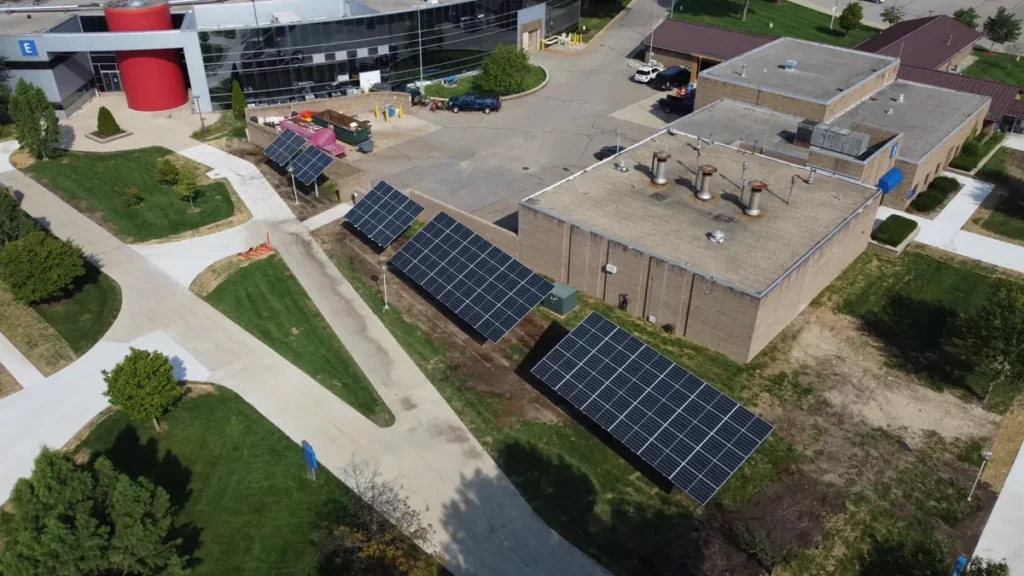
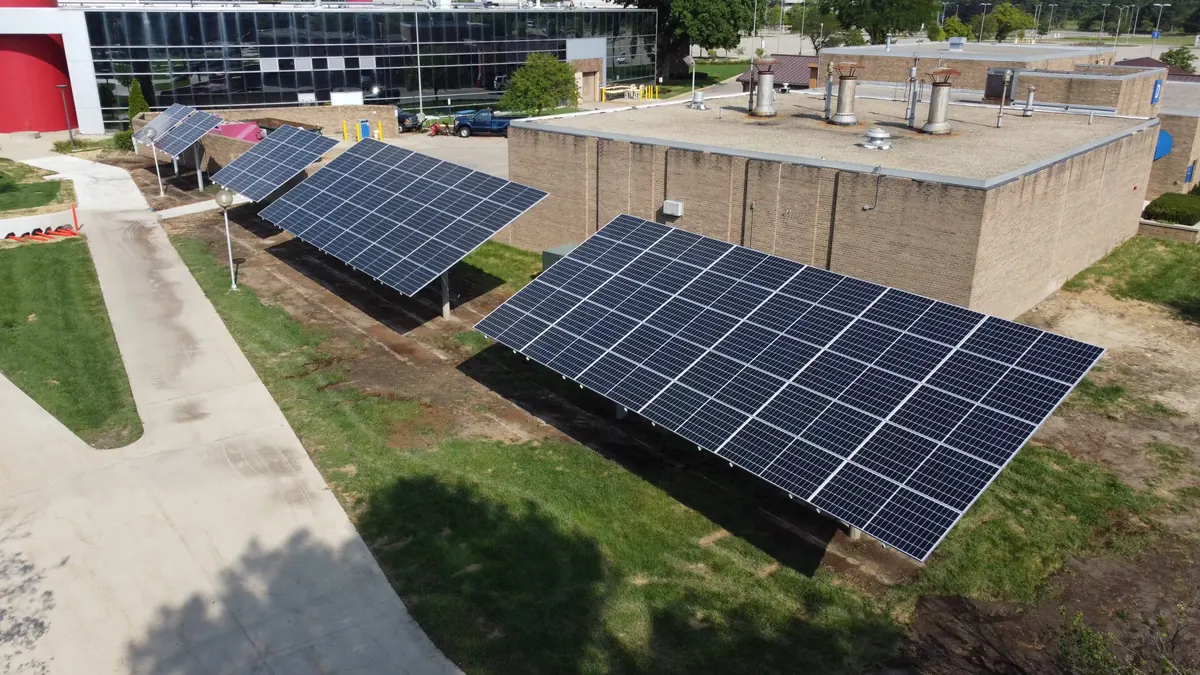
(84 panels on five adjustable pole mounts)
Project Overview
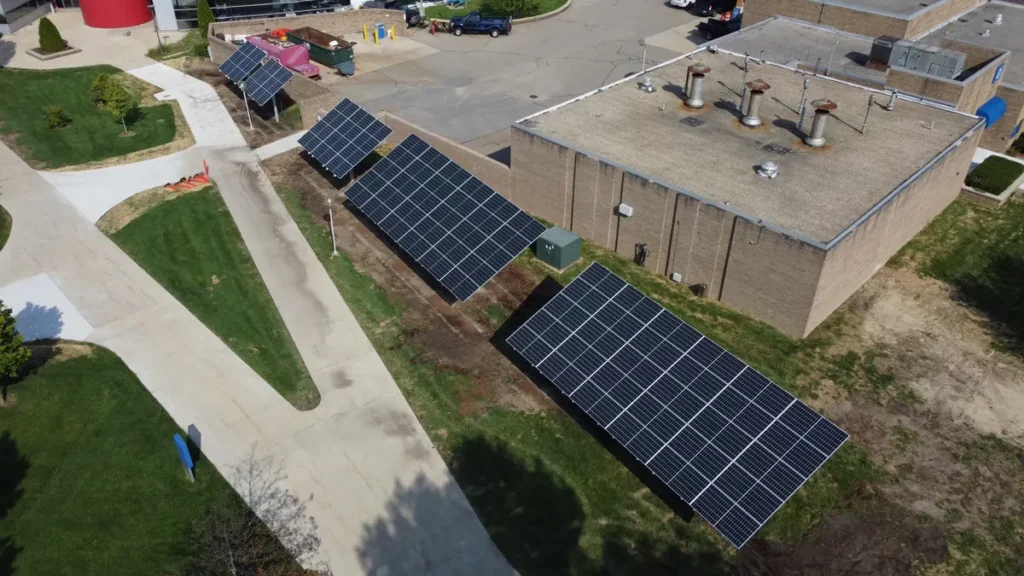
Henry Ford College (formerly Henry Ford Community College) in Dearborn wanted a solar array its students could learn from. The goal was a carbon-free, renewable energy source to supplement the electricity needs of the campus’s Technology Building, and a way to give students a working look at how energy is produced.
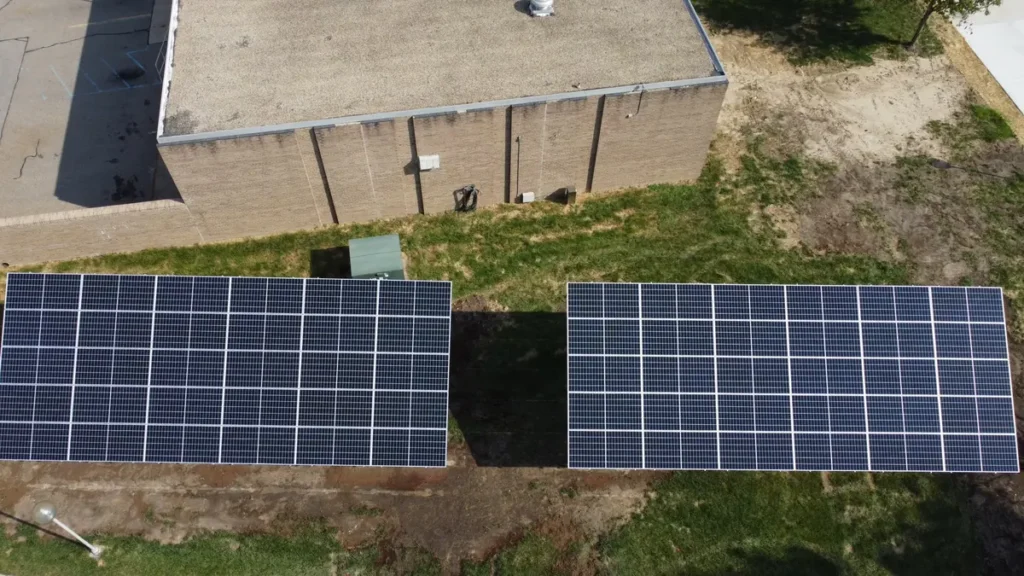
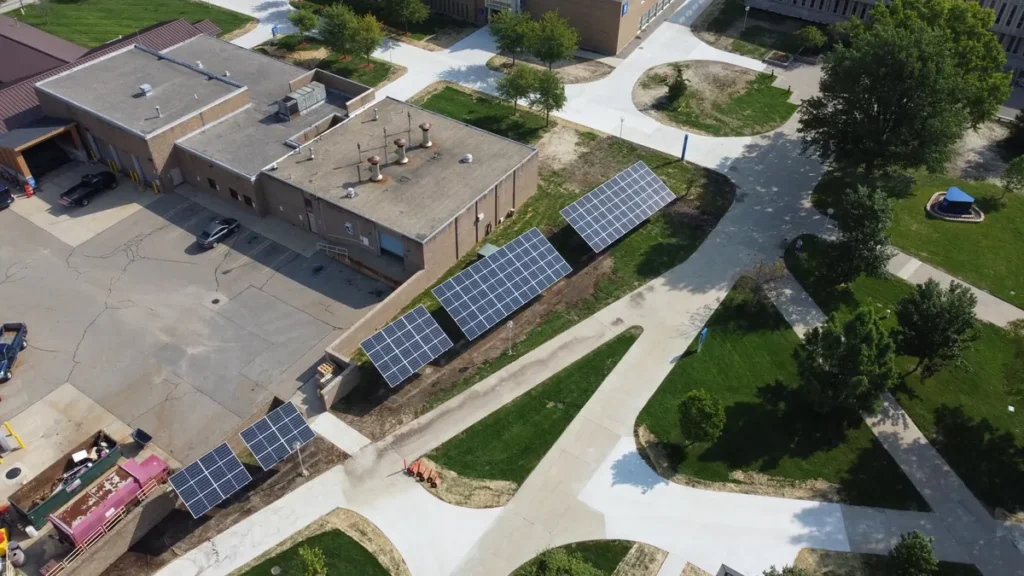
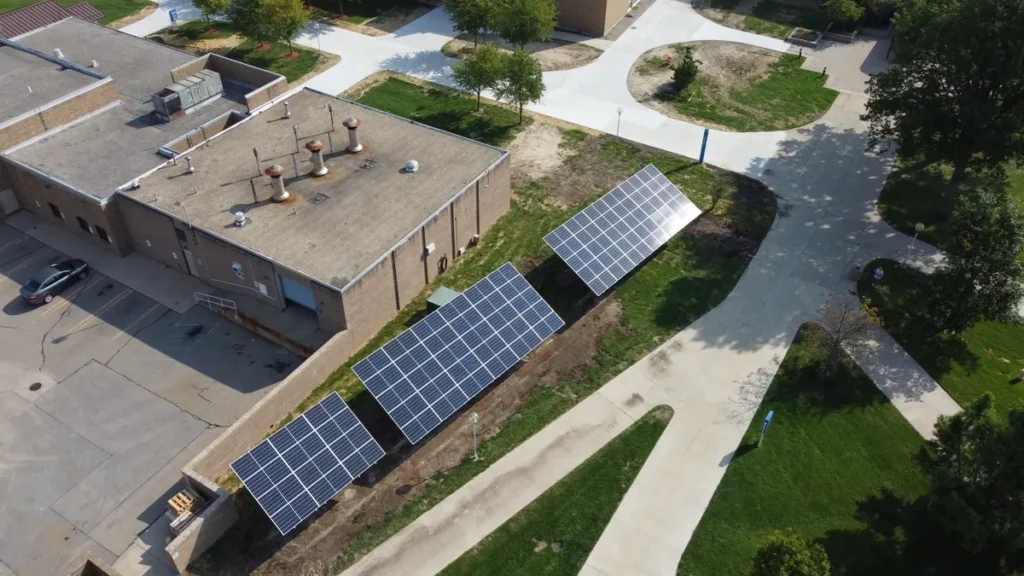
In 2021 we installed a 35.7 kW ground-mounted array for the college as a subcontractor to Detroit Power Systems, a Detroit-based electrical contractor. The system pairs 84 Q.Cells 425W panels with 84 Enphase microinverters, one under each panel, spread across five single-tilt adjustable pole mounts. Our crew excavated and poured the foundations, set the support pipes, assembled the mounts, and installed every panel, while Detroit Power Systems handled the electrical connection to the building.
Monitoring and educational displays were part of our contract from the start, so the array works as a teaching tool as well as a power source. Production can be viewed for the whole system or panel by panel, and indoor and outdoor signage walks visitors through how it all works.
How the Project Came Together
FEBRUARY 2021
SCOPE AND SUBMITTAL
A 35.7 kW Pole Mount Design and a Clear Split of Responsibilities
Our material and scope submittal to Detroit Power Systems laid out the equipment list, which company would handle each part of the work, and ideas for putting the system’s production data in front of students. The subcontract was signed in March 2021.
APRIL 2021
ENGINEERING AND PERMIT
Sealed Structural Drawings and a State Building Permit
A Michigan-licensed professional engineer sealed the structural drawings for the pole frames and concrete foundations on April 20, 2021. Nine days later, the State of Michigan Bureau of Construction Codes issued the building permit for the installation under the education use group.
MAY TO JULY 2021
FOUNDATIONS AND INSTALLATION
Five Pole Mounts Set in Concrete and 84 Panels Installed
The post holes were dug and most of the support pipes set by mid-May. Concrete, mounts, rails, microinverters, and panels followed, and our installation work was complete by the end of July 2021.
Project Planning
Henry Ford College’s solar array was one of several facility improvement measures in a larger performance contract between the college and Johnson Controls, running alongside district heating, HVAC, building controls, lighting, water conservation, and building envelope work. With that much happening on an occupied campus, we joined the program’s progress meetings with Johnson Controls, the college’s facilities team, Detroit Power Systems, and the other firms on the project. Those meetings covered everything from campus delivery protocols for our skids and poles to coordination with the college’s electrician. The college was also in the middle of a major renovation of the building that houses the system’s electrical tie-in point.
Our scope was the array itself. Detroit Power Systems took on the electrical work between the array and the building, including directional boring for the conduit runs from the poles to the building, the AC wiring, the connection to the building’s electrical service, and scheduling inspections.
Prepared the engineering plan set for permitting, with structural drawings for the pole frames and foundations sealed by a Michigan-licensed professional engineer
Pole frames and foundations engineered for 105 mph wind at Exposure B and a 20 psf ground snow load
Excavated and poured reinforced concrete foundations for the support pipes
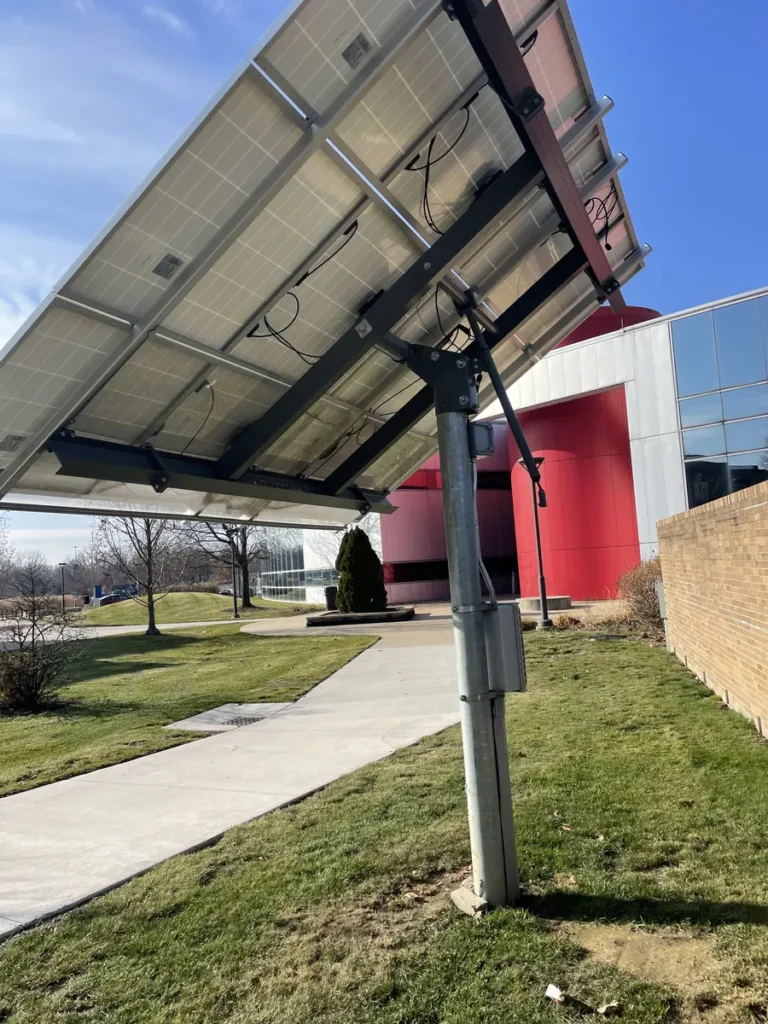
Assembled five single-tilt adjustable top-of-pole mounts from MT Solar and fitted them with IronRidge XR1000 rails
Attached the panels and microinverters to the rails, then lifted each assembled mount into position on its support pipes
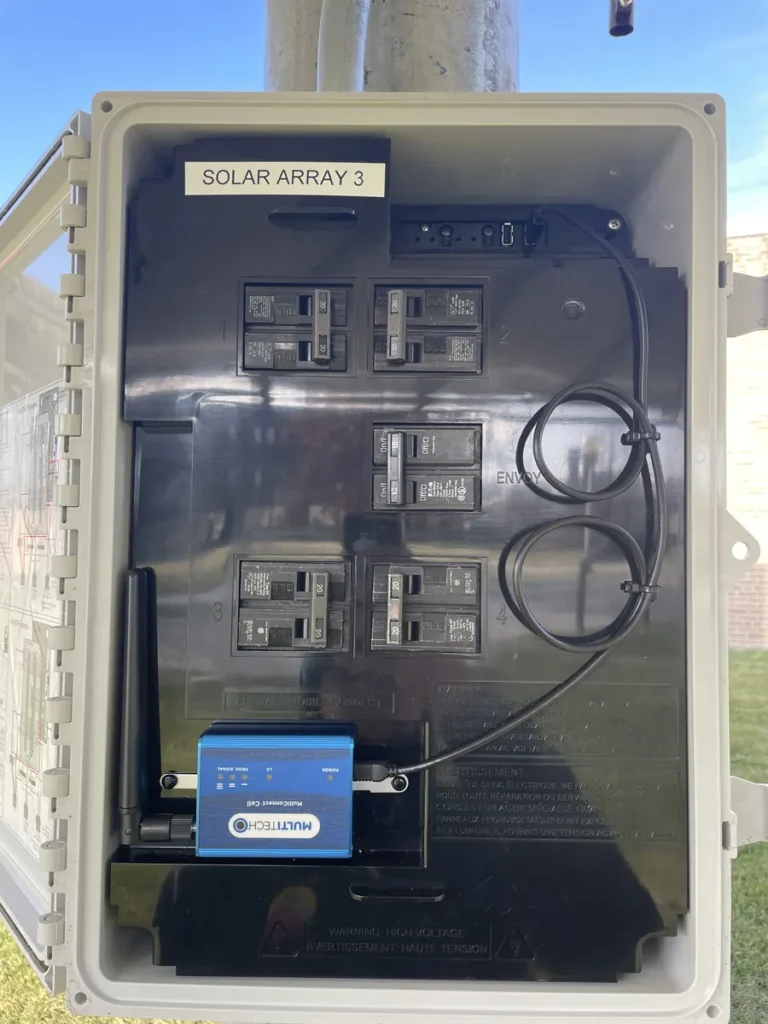
Supplied three Enphase IQ Combiners, one for each array group, each with its own monitoring gateway
Worked under Johnson Controls’ subcontractor safety specifications throughout the project
Is there open land on your campus that could be producing power?
We handle the engineering, the permitting paperwork, the foundations, and the installation.
or call
Learn more about solar for schools
Proposal & Design
The design focuses on two things: production through Michigan’s changing seasons and visibility into how the system performs. Adjustable single-tilt mounts let the panel angle be changed through the year as the sun’s path shifts, with the panels set at their steepest angle, 35 degrees, when snow is present. Pairing each panel with its own microinverter means production can be tracked one panel at a time, so students can compare output across the five arrays.
2021 Installation
35.7 kW DC
PANELS
84 × Q.Cells Q.PEAK DUO L-G8.2 425W
Monocrystalline half-cell modules, 425W each, for a 35.7 kW nameplate
MICROINVERTERS
84 × Enphase IQ7A
One Enphase microinverter per panel, converting DC to AC right at the module
COMBINERS & MONITORING
3 × Enphase IQ Combiner
One per array group, each with a built-in gateway that reports production to Enphase monitoring
MOUNTS
5 × MT Solar top-of-pole mounts
Single-tilt adjustable frames set in concrete, with the larger arrays on two poles and the smaller ones on one
RAILS
IronRidge XR1000
Heavy-duty rails carrying the panels on each pole frame
STRUCTURAL BASIS
105 mph wind / 20 psf snow
Exposure B, sealed by a Michigan-licensed professional engineer
Educational Displays
Each Enphase gateway sends production data to Enphase’s monitoring platform, where the college can check system health, view production by month, day, or hour, and see output for the full system or for individual panels. Because the arrays sit at different positions and can be tilted independently, the per-panel data lets students compare how location and angle affect production.
The system’s production is also public. Anyone can follow how the array is performing day by day, month by month, and year over year on its Enphase monitoring page. Strawberry Solar is listed there as both the installer and the maintainer of the system. Our solar service and maintenance covers monitoring, troubleshooting, and support after installation.
See the System’s ProductionEducational signage puts that information in context. An outdoor 24 by 36 inch display designed to stand near the array covers the system’s equipment, how photovoltaic panels turn sunlight into usable electricity, and the environmental, social, and economic case for solar. A set of 11 by 14 inch interior panels carries the same material indoors, and the outdoor sign points visitors to a monitor inside the building where they can watch the system perform.
Benefits & Impact
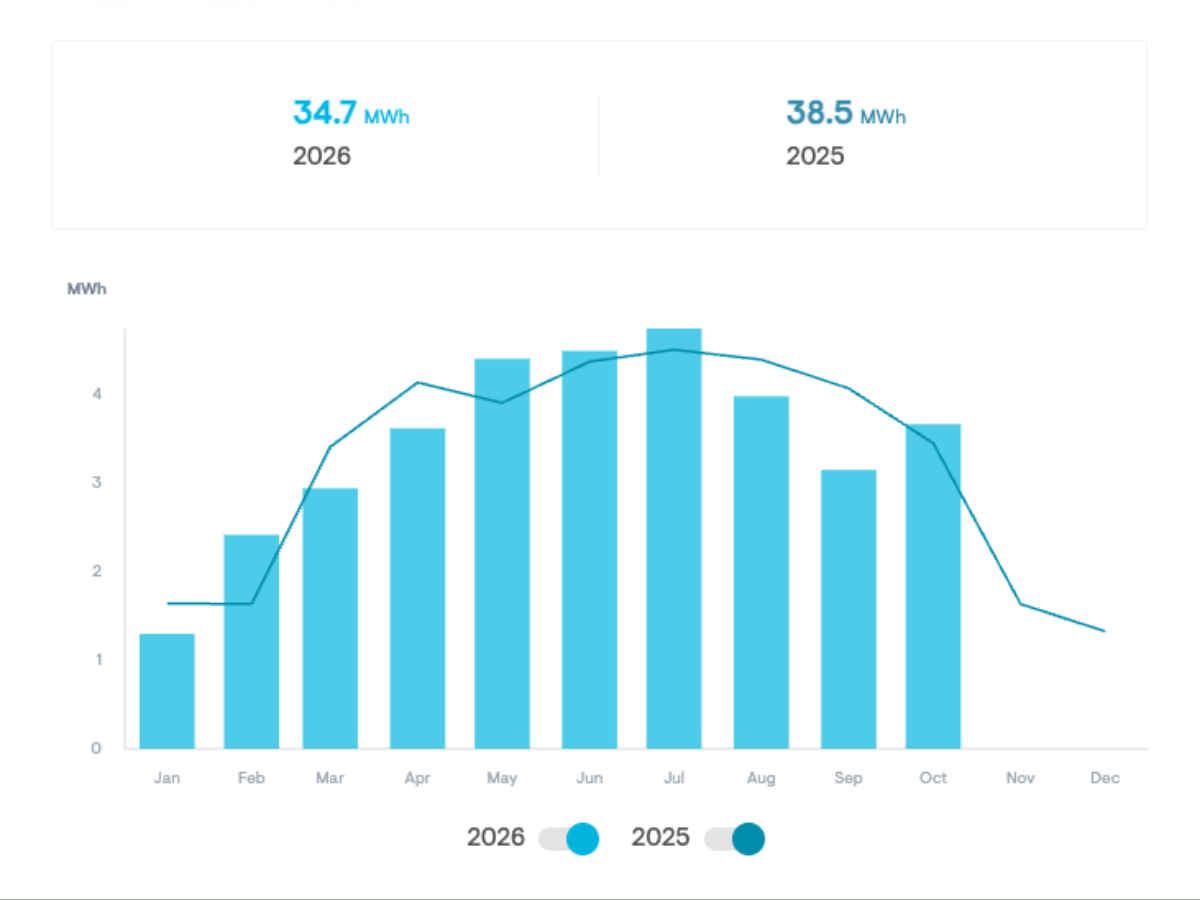
The array produced 39.5 MWh of electricity for the Technology Building in 2024 and 38.5 MWh in 2025, with output peaking in late spring and summer and dropping through the winter months.
35.7 kW
DC system size across five adjustable pole mounts
84
Panels, each with its own microinverter
~39,000
kWh produced per year in 2024 and 2025
For schools weighing a similar project, Henry Ford College shows how a commercial solar installation can fit inside a larger campus upgrade program. We worked under an electrical contractor and a general contractor, kept our scope to the array, and coordinated through the program’s existing meetings and safety requirements. For a rooftop example, our Boggs School project in Detroit put solar on a working K-8 school’s flat roof.
Incentives for colleges and other educational institutions depend on where the campus is and which programs are open at the time. It’s worth checking what applies to your school before you budget for a project.
The Solar Project Team

Will Held
Managing Partner

Seger Weisberg
Sales Manager
Thinking about solar for your school or nonprofit?
Free site assessment. No pressure. Detroit based team since 2010.