
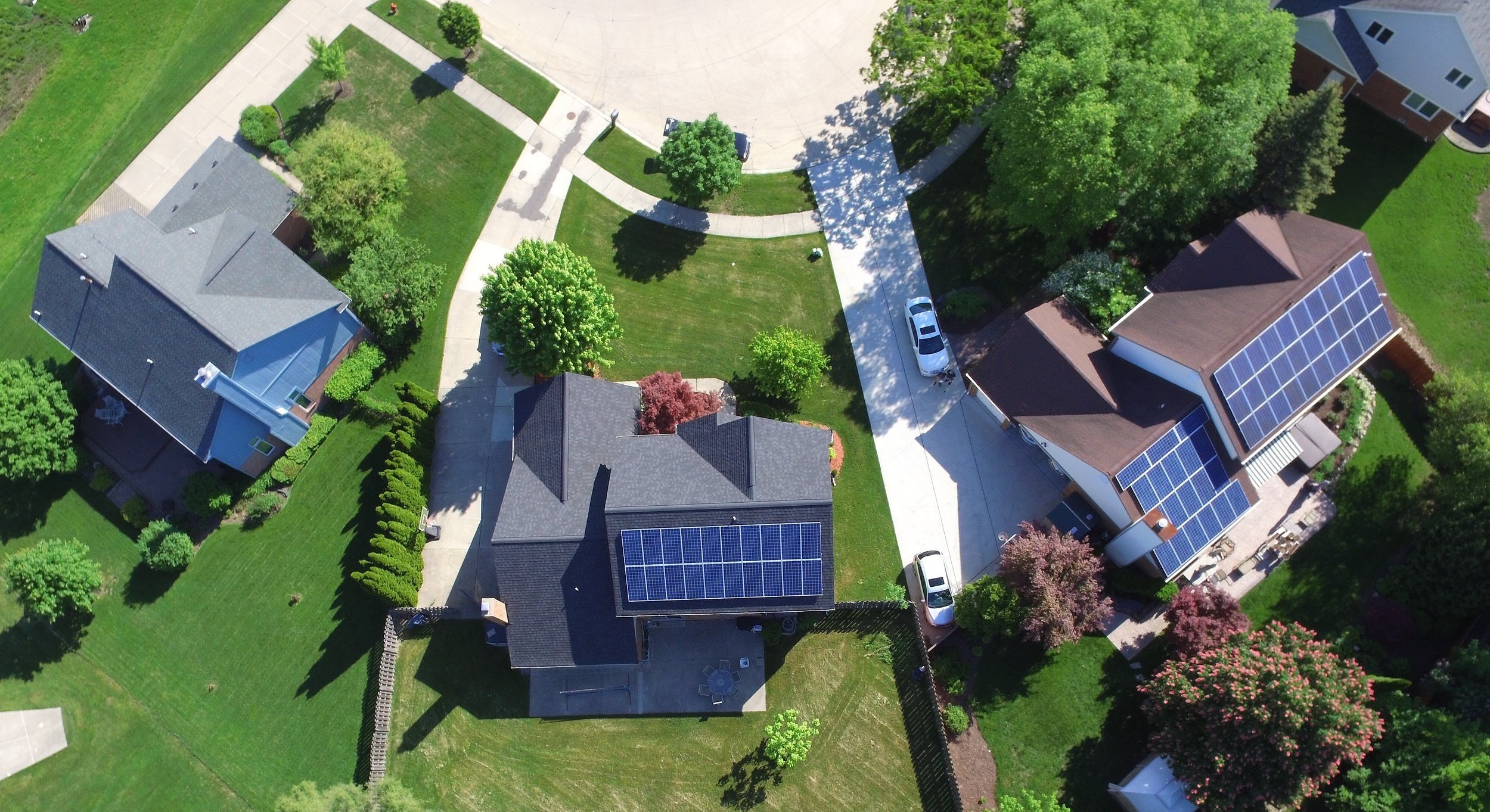

You have probably seen the pitch. Solar panels on your roof, nothing due at signing, and a power bill that drops the day the system turns on. It sounds like someone is giving away solar, but that’s not really the case.
What is usually being offered is a power purchase agreement, and it is not a discount on solar. It is a different arrangement entirely, with a different owner, a different set of benefits, and a different answer to the question of who comes out ahead in year twenty. Some of our customers have looked hard at PPAs and walked away. Some have signed one and been glad they did. The difference includes many factors that are worth thinking through.
Key Points
- A power purchase agreement (PPA) means a third party owns the solar system on your property, and you buy the electricity it produces at an agreed rate per kilowatt-hour.
- Michigan is among the states that authorize third-party solar PPAs. DSIRE cites 2008 Public Act 286 and Michigan Public Service Commission Order U-15787.
- Statewide authorization does not automatically reach every utility. Municipal utilities and rural cooperatives can take a different position than DTE Energy and Consumers Energy.
- You do not own the system, so the tax treatment, the equity, and the long-term savings belong to the owner.
- PPAs often fit best for organizations that cannot use tax incentives themselves, including churches, schools, nonprofits, and local governments.
What Is a Solar Power Purchase Agreement?
In a solar PPA, a third-party developer owns, operates, and maintains the system. You agree to host it on your roof or your land, and you buy the electricity it generates for a set period, usually somewhere between fifteen and twenty-five years. The EPA describes the customer in this arrangement as buying the services the system produces rather than the system itself, and that is the clearest way to think about it.
You are not buying panels or batteries. You are buying kilowatt-hours from a company that happens to be generating them on your property. The rate is typically set at or slightly below what your utility charges, and many agreements include an annual escalator that raises it a percent or two every year.
This is often viewed as similar to a solar lease, and there are many similarities, but it is different. The distinction is small but real: under a lease you pay a flat monthly amount for the use of the equipment regardless of what it produces, while under a PPA you pay only for the power that actually comes off the roof.
Power Purchase Agreement
You pay per kilowatt-hour for the power the system actually produces. A cloudy month means a smaller solar bill and a larger utility bill.
Solar Lease
You pay a fixed monthly amount for the equipment. Production risk sits with you, and a weak month does not lower the payment.
Solar PPAs vs. Utility-Scale Power Purchase Agreements
Search for “power purchase agreement” and you will hit two completely different things wearing the same name.
The first is what we have been describing: a system on your building, sized for your usage. The second is a contract between a utility and a large generator. When the Michigan Public Service Commission approved a PPA between Consumers Energy and the 150 megawatt Watertown Solar Project in Sanilac County, that was a power purchase agreement too. Consumers is the buyer from a solar farm as the seller. These are similar to homeowner- or busness-level PPAs, but are at a different scale with many separate nuances.
Are Solar Power Purchase Agreements Legal in Michigan?
Yes, PPAs are legal and quite common throughout Michigan.
DSIRE, the national database run by the N.C. Clean Energy Technology Center, tracks which states authorize third-party solar PPAs, and its May 2026 map lists Michigan among them, citing 2008 Public Act 286 and Michigan Public Service Commission Order Docket U-15787 as the legal basis. Michigan sits alongside at least twenty-eight other states plus Washington DC, Puerto Rico, and the Northern Mariana Islands.
Why Your Utility Decides Whether a PPA Is an Option
DSIRE is explicit that states authorizing third-party PPAs have not necessarily done so in every jurisdiction, and that municipal utilities may not allow them in their territories even where they are permitted in investor-owned utility territories.
Michigan has both. DTE Energy and Consumers Energy are investor-owned utilities regulated by the MPSC, and together they cover most of the Lower Peninsula. But plenty of Michigan communities are served by municipal utilities or rural electric cooperatives that run under different rules. If your power comes from a city-owned utility or a co-op rather than DTE or Consumers, the statewide answer does not automatically apply to you, and the first call is to your utility.
Check Your Utility Before You Get Attached to the Idea
Statewide authorization is a starting point, not a guarantee for your address. If a municipal utility or a cooperative serves your property, confirm their position on third-party owned systems before you go far down this road. DSIRE notes plainly that its information is a public service and not legal advice, and we would say the same about this article. A PPA is a long contract. Have someone qualified read it.
How a Solar PPA Works in Michigan
1
Utility check
Confirm your utility permits third-party owned systems at your address. This step comes first for a reason. Everything after it depends on the answer.
2
Site assessment
Someone evaluates the roof, the shading, the electrical service, and your usage history. A PPA provider is investing in this system for two decades, so they look closely.
3
System design
The system gets sized against your actual consumption, not against how much roof you have.
4
The agreement
Rate per kilowatt-hour, term length, escalator, buyout provisions, and what happens if you sell. This is the document that determines whether this was a good idea.
5
Permitting
Michigan has no statewide solar permit, so requirements come down to your city or township building department.
6
Installation
The array goes up, the electrical work gets done, and the building department inspects it.
7
Interconnection
The system connects under your utility’s distributed generation program, which governs how you are credited for anything you send back to the grid.
8
You start buying power
The meter goes in and the arrangement begins.
Steps two through seven are where we do our work. On a PPA the financing partner owns the outcome, but the site assessment, the system design, the permit applications, the installation, and the interconnection paperwork all still have to be done right, and that is our end of it.
Not Sure Which Path Fits Your Property?
We will look at your bills, your roof, and your goals, and help you decide the most effective path to solar.
Get a QuoteWhat You Give Up With a Solar PPA
The trade off is fairly straightforward. The asset on your roof belongs to someone else for the length of the term, and everything that follows from ownership follows to them.
That includes decisions you might assume are yours. Which panels go up, how fast a repair gets scheduled, what monitoring you can see: all of it is the owner’s call, governed by whatever the contract says. A good agreement handles these questions well. A bad one leaves them vague, and unfortunately most find out which kind they signed at the worst possible moment.
Then there is the escalator. Most PPAs raise the rate every year, often by a percent or two, and two percent compounds. Over twenty years that is not a rounding error. The pitch usually compares year one against your current bill, which is the comparison that flatters the PPA most. Ask for the rate in year ten and year twenty, and put it next to what you actually believe your utility rate will do over the same stretch. If nobody can tell you what the rate is in year fifteen, that is the answer.
Ask about the end of the term while you are at it. Some agreements offer a buyout, some offer renewal, some remove the system and restore the roof. Some are quiet about it. Year twenty-five feels a long way off when you are signing, and it arrives anyway.
The tax credit picture changed recently, and a lot of what is written about PPAs online has not caught up. The federal residential credit that homeowners claimed on a system they bought themselves, Section 25D, ended after 2025. If a salesperson quotes you a PPA rate that leans on a federal tax credit, ask them to show you exactly where that credit comes from and get the answer in writing. Under a PPA the tax treatment belongs to the system owner regardless, never to you. That part is structural and it does not change.
Our team has written before about how financing choices follow you to closing. If you expect to move, the resale question is worth reading up on in how solar affects your home’s value in Michigan and in the mistakes we see most often when people go solar before you commit to a twenty-year contract.
When a Solar PPA Makes Sense
Everything above is the case against a PPA for a typical Michigan homeowner who plans to stay put. That is not everyone.
The strongest case for a PPA is an organization that cannot use tax incentives at all. A church, a school district, a nonprofit, a municipality: these entities have no federal tax liability, so a credit is worth nothing to them directly. Third-party ownership grew up around exactly that problem, letting a partner who can use the benefits own the system while the host simply gets the power. The federal picture has tightened considerably, so the planning is harder than it was a year ago. Test any rate you are quoted against what your utility actually charges you today.
Michigan has real examples. The City of Muskegon signed a rooftop PPA to bring solar power downtown, pairing the agreement with a site lease on city-owned premises. That is a municipality getting solar on its buildings without a capital appropriation.
The case also holds up when capital is genuinely the obstacle, or when maintenance is something you want off your plate entirely. Under a PPA, the owner is responsible for keeping the system running, because their revenue depends on it producing. Through a Michigan winter, that alignment has some value.
PPA is not is free solar. Somebody is paying for those panels, and over twenty-five years, a good deal of that somebody is you.
Questions to Ask Before Signing a Solar PPA
- Rate and escalator. What is the starting rate per kilowatt-hour, and does it increase annually? By how much?
- Term length. How many years, and when does the clock start?
- Buyout. Can you purchase the system, when, and how is the price determined?
- Selling your home. Does the buyer assume the contract? What happens if they refuse?
- Production guarantee. Is output guaranteed? What is the remedy if it underperforms?
- Snow and weather. Who is responsible when a Michigan winter buries the array?
- Roof penetrations. Who warranties the roof work, and what happens if the roof needs replacing mid-term?
- End of term. Buyout, renewal, or removal? Who pays for removal, and is the roof restored?
- What is the rate built on? Ask what assumptions the quoted rate depends on, including any incentive the provider expects to receive. If an assumption fails, find out who absorbs it.
How Strawberry Solar Supports PPA Installations
In a PPA, the system belongs to the financing partner, not to us and not to you. However, we can still function as the installer and work through the entire process with you and the owner.
We have worked with PPAs before, and we know how to navigate the setup and the paperwork. The permitting varies by municipality and we handle all of it on your behalf. The interconnection process with DTE and Consumers has its own requirements and its own timelines, and we have been through both many times since 2010. When a third party owns the system, there are more parties to coordinate and more documentation to get right, and a bad handoff between the financing partner, the installer, and the utility is how a project stalls for months.
We are also manufacturer-agnostic, which matters more than it sounds like it should. We design around your building and your usage rather than around whatever equipment we are trying to move.
And if you come to us asking about a PPA and we think ownership serves you better, we will tell you that. Our solar financing options page covers what most of our customers actually use, and residential solar installation and commercial solar installation walk through what the work looks like. The right answer depends on your financial situation, your timeline, your energy needs, and your building. It is not the same for anybody, and we would rather have the honest conversation than the easy one.
Start With a Conversation
We have been designing and installing solar across the Michigan Lower Peninsula since 2010. Bring us your bills and your questions.
Let’s Talk