
Now Installing in Michigan

Energy Vehicle-to-Home

Turn Your GM EV Into a Whole-Home Backup Power System
V2H (Vehicle-to-Home) technology transforms your EV into a mobile power station, providing backup electricity during outages and reducing your energy costs by up to 40%. GM Energy offers the most complete system available today, and we install it along with other V2H-capable EVs across Michigan.
Strawberry Solar brings Michigan homeowners cutting-edge V2H technology backed by 15+ years of solar and electric vehicle installation experience. We’ve helped hundreds of families across Metro Detroit and Lower Michigan achieve energy independence – now it’s your turn.
We are an award winning Michigan solar installation company.



Your EV Can Power Your Entire Home
V2H (Vehicle-to-Home) technology turns your electric vehicle into a mobile power station. When the grid goes down, your EV keeps the lights, heat, and essentials running. GM Energy offers the most complete home solution on the market today, and it is the system we install most often for Michigan drivers.
Pearl Certified installerAuthorized Michigan Saves contractorInstalling solar since 2010
Not a GM driver? We also install V2H for Ford, the Tesla Cybertruck, Hyundai, and Kia.




Why GM leads V2H
GM Energy Has the Most Complete Vehicle-to-Home System Available Today
GM Energy pairs the PowerShift Charger with the V2H Enablement Kit so a compatible GM EV can send power back to your home during an outage. It works across V2H-capable Ultium vehicles from Chevrolet, GMC, and Cadillac, and it is the setup we install most often for Michigan homeowners.
246,000+
V2H-capable GM EVs sold
up to 21 days
of backup from a large-battery Silverado EV*
9.6 kW
GM Energy inverter in the kit
*Runtime depends on your vehicle’s battery size, your home’s energy use, and how the system is configured. Some 2024 GM EVs need a dealer or over-the-air update to enable bidirectional charging. We confirm compatibility for your exact model and year before any work begins.
What a GM Energy V2H system includes
›
GM Energy PowerShift Charger. Level 2 charging plus the bidirectional hardware that moves power both ways.
›
GM Energy V2H Enablement Kit. Home Hub, a 9.6 kW inverter, and a dark start battery to bring the system online during an outage.
›
Optional GM Energy PowerBank. A fixed home battery for homes that want stored power even when the vehicle is away.
›
Professional install and permitting. Panel evaluation, interconnection, and inspection handled by our team.
The Basics
What is V2H Technology?
Vehicle-to-home charging, also known as “EV to Home”, allows an electric vehicle’s battery to power a home, typically as a backup during a power outage. Think of your EV as a massive battery on wheels capable of storing 60-200 kWh of energy, which is enough to power the average Michigan home for several days or even weeks.
V2H helps solve three problems for Michigan homeowners:
- Power outage protection. Power outages are becoming more frequent and unpredictable across Michigan. Whether it’s summer storms, winter ice or aging grid infrastructure, losing electricity means more than just inconvenience.
- Combating the rising cost of energy. Peak-hour electricity rates can be 2-3 times higher than off-peak rates, making it expensive to run your home when you actually need power most.
- Selling energy back to the grid at wholesale prices. If you’ve invested in solar panels, you’re likely selling excess energy back to the grid at wholesale prices which are far less than what you pay to buy it back at night, your EV can help offset this extra cost helping keep your home running when the sun isn’t shining.
Instead of your EV sitting idle in the garage for 22+ hours per day, it can become a mobile power station capable of keeping your entire home running.
How It Works
How Does Vehicle-to-Home Charging Work?
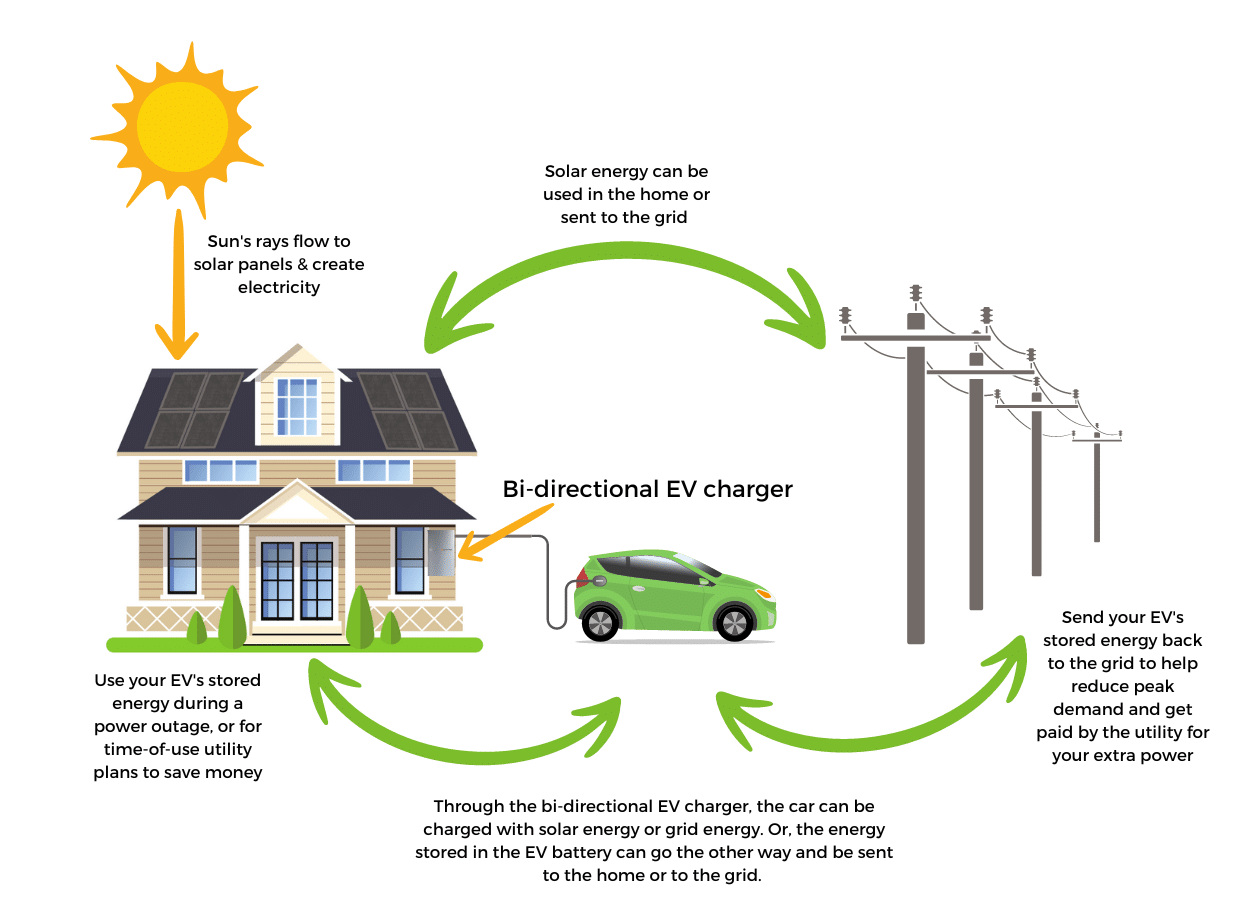
The system operates seamlessly in the background while you go about your daily life. Here’s the simple 4-step process that transforms your electric vehicle into a reliable home power source.
Step 1: Charging Mode
Your EV charges like it always does. Plug it in and the battery fills with electricity from your home’s grid connection or solar panels throughout the day.
At this point you’re simply storing energy for later use. Most homeowners charge overnight when electricity rates are lowest or during the day when solar panels are producing peak power.
Step 2: Energy Storage
The power stays stored in your vehicle’s battery. Think of this as your mobile energy reservoir. Unlike a traditional home battery that sits idle, your EV battery serves dual purposes: powering your vehicle when you drive and powering your home when you’re parked.
Step 3: Power Conversion
When you need to use your EV’s stored energy for your home, the bidirectional charger does the heavy lifting. It converts the DC power from your vehicle’s battery into AC (alternating current) power that your home appliances and electrical systems use. This happens automatically and instantly based on your settings or when the grid goes down.
Step 4: Smart Management
The energy management system is the brain of your V2H setup. It monitors your home’s energy needs, tracks your EV’s battery level and decides when to pull power from the grid versus your vehicle. You control everything through a simple smartphone app where you can set priorities like “always keep 50% battery for driving” or “use EV power during peak rate hours.”
See What Your EV Can Power
Tell us your vehicle and home setup and we’ll confirm compatibility and map out your backup options across Michigan. No cost, no pressure.
or call
V2H Value
Why Install V2H for Your Home?
Michigan homeowners face unique energy challenges from severe weather outages to rising electricity costs. V2H technology addresses these problems head-on while delivering benefits that pay dividends year after year. Here’s what you gain when Strawberry Solar installs a V2H system in your home.
Benefit #1
Emergency Backup Power During Outages
Power outages are becoming more frequent across Michigan. Whether it’s summer storms, winter ice or aging infrastructure, losing electricity means more than inconvenience. It means spoiled food, no heating or cooling and being cut off from the essentials your family depends on.
With V2H technology, your electric vehicle becomes a silent automatic backup power system that keeps your entire home running:
Lights stay on so your family feels safe and secure
Refrigerators and freezers keep running protecting hundreds of dollars in groceries
Medical devices remain operational for family members who depend on them
Heating and cooling systems work maintaining comfortable temperatures
Internet and phones stay connected keeping you in touch during emergencies
Sump pumps continue operating protecting your basement from flooding
How long will your power last?
Most V2H systems provide 3-7 days of backup power with normal usage. Larger battery EVs like the Chevy Silverado EV can power your home for up to 21 days with some conservation. That’s far longer than most outages last.
No generators needed.
Forget about noisy gas generators that require fuel storage, regular maintenance and produce emissions. Your V2H system activates automatically within seconds of an outage and runs whisper-quiet.
Benefit #2
Lower Your Energy Costs with Smart Power Management
DTE Energy customers pay significantly more for electricity during peak hours (3 p.m. to 7 p.m. on weekdays). During summer months (June-September), peak rates jump to 22 cents per kWh while off-peak rates drop to just 16 cents per kWh. That’s a 38% difference.
V2H lets you beat peak pricing:
Charge your EV overnight or on weekends when rates are lowest (16 cents/kWh)
During expensive peak hours, use the stored energy from your EV instead of buying from the grid at 22 cents/kWh
Your energy management system handles this automatically based on your preferences
The savings add up fast. A typical Michigan home uses about 10-15 kWh during the 4-hour peak period each weekday. By using your EV’s stored power instead of grid electricity during these hours, you could save:
Summer months
$50-75 per month in peak rate avoidance
Year-round savings
$400-700 annually depending on usage patterns
For families with time-of-use rates, V2H technology transforms your EV from a vehicle into a money-saving energy asset that pays for itself over time.
Benefit #3
Maximize Your Solar Investment
If you’ve invested in solar panels, you already know the frustration: your panels produce excess energy during the day when you’re at work and electricity is cheaper, then you buy power back at night when it’s more expensive. Net metering helps but you’re essentially selling your solar energy wholesale and buying it back retail.
V2H solves this problem by turning your EV into solar storage:
Morning: Solar panels start generating electricity as the sun rises
Daytime: Excess solar energy charges your EV battery instead of going back to the grid
Evening: Use that stored solar power to run your home when the sun sets
Night: Your home runs on clean solar energy you produced and stored yourself
Create a closed-loop renewable energy system. With V2H and solar working together, you can achieve near-complete energy independence. You’re no longer dependent on utility companies or subject to their rate changes. You produce it, you store it, you use it.
Better economics than selling back to the grid.
Instead of receiving wholesale rates for excess solar production, you’re using 100% of your solar energy on-site at full retail value. This dramatically improves your solar ROI.
Environmental impact multiplied.
When you pair V2H with solar, you’re powering both your home and your transportation with clean renewable energy. Your carbon footprint drops significantly.
Benefit #4
Energy Independence and Control
Michigan’s power grid faces increasing strain from extreme weather, aging infrastructure and growing demand. Rolling blackouts and planned outages may become more common as utilities struggle to maintain reliable service.
V2H gives you independence from these problems:
Reduce grid dependency by using your own stored energy during peak demand
Avoid rolling blackouts when utilities implement load shedding
Control your energy usage instead of being at the mercy of utility schedules
Protect against rate increases by storing power when rates are low
Maintain power during planned outages for maintenance or repairs
Peace of mind for your family.
Knowing your home can operate independently from the grid for days or weeks provides invaluable security. You’re not wondering if the power will stay on. You’re not worrying about spoiled food or uncomfortable temperatures. You’re in control.
Grid-friendly technology.
While V2H gives you independence, it also helps the entire grid operate more efficiently. By reducing demand during peak hours, you’re easing strain on the utility infrastructure and helping prevent broader outages.
Benefit #5
Reduce Your Environmental Impact
Climate change is already affecting Michigan with more severe storms, temperature extremes and unpredictable weather. Every step toward clean energy makes a difference.
V2H technology supports environmental goals:
Lower carbon emissions when paired with solar power
Maximize renewable energy use by storing solar production instead of wasting it
Reduce fossil fuel dependency for both transportation and home energy
Support grid stability during peak demand periods when utilities rely on dirtier “peaker plants”
Improve air quality in your community by reducing reliance on fossil fuel generation
Double the impact of your EV. You already made an environmentally conscious choice by buying an electric vehicle. V2H technology multiplies that impact by using your EV’s battery to displace fossil fuel-generated electricity in your home.
Help Michigan’s clean energy transition.
As more homeowners adopt V2H technology, it creates distributed energy storage across the grid. This makes it easier to integrate renewable energy sources and reduce reliance on coal and natural gas plants.
Lead by example.
When your neighbors see your lights on during outages and hear about your energy savings, you’re demonstrating how clean technology delivers real practical benefits. You’re helping accelerate the adoption of sustainable solutions.
Compatibility
Which Electric Vehicles Support V2H?
Not all electric vehicles support bidirectional charging yet, but the technology is expanding rapidly. If you own an EV from one of the brands below or are shopping for your next vehicle, you can take advantage of V2H technology with a professional installation from Strawberry Solar.
Most Complete Today
GM (Chevrolet, GMC, Cadillac)
V2H-capable Ultium EVs paired with the GM Energy PowerShift Charger and V2H Enablement Kit. The system we install most often in Michigan.
Ford
Select Ford EVs support home backup with the right home integration hardware. We confirm your model’s setup before install.
Tesla Cybertruck
Tesla Powershare currently supports vehicle-to-home on the Cybertruck only, using Tesla’s home energy equipment. More vehicle models are planned to be added to the V2H capable fleet.
Hyundai
Bidirectional capability is expanding across Hyundai’s EV lineup. Ask us about your specific model and year.
Kia
Kia is rolling out bidirectional features on newer models. We will check compatibility for your vehicle.
Don’t see your vehicle?
V2H is moving quickly. Tell us your make, model, and year and we will confirm current or upcoming support, and help if you are shopping for a V2H-ready EV.
Active EV-to-Home Programs Available Today
While many automakers are still developing bidirectional charging, two programs currently stand out for homeowners who want to use an electric vehicle as part of a home backup power system. Strawberry Solar works directly with these platforms to determine compatibility, design safe system layouts, and handle professional installation.
GM Energy
GM Energy currently offers the most complete EV-to-home solution on the market for compatible Ultium-based vehicles. When installed with the GM Energy PowerShift Charger and required V2H enablement equipment, select GM EVs can supply power back to a home during outages or other grid interruptions.
This system allows a properly configured vehicle to act as a temporary backup power source for essential household circuits. Actual runtime depends on vehicle battery size and home energy usage. Strawberry Solar evaluates your electrical panel, backup power goals, and utility requirements to determine whether a GM Energy V2H system is a practical fit for your home.
Tesla Powershare (Cybertruck Only)
Tesla Powershare is currently available exclusively on the Tesla Cybertruck. With the correct Tesla home energy equipment, the Cybertruck can export power to a home during an outage, supplying enough capacity to support critical loads and selected circuits.
At this time, no other Tesla vehicles support vehicle-to-home power. Strawberry Solar helps homeowners understand how Powershare integrates with existing or planned Tesla energy systems and whether it meets their backup power needs.
Schedule Your Free V2H Assessment
Tell us your EV make, model, and year and we’ll confirm V2H compatibility, evaluate your panel and backup goals, and size the right system for your home, from GM Energy to other V2H-capable platforms. You’ll get a transparent quote with no obligation.
or call
Cost & Financing
V2H System Installation Costs
Investing in V2H technology requires upfront costs but the long-term benefits and available incentives make it a smart financial decision for many Michigan homeowners. Here’s everything you need to know about pricing, incentives and return on investment.
The true cost of installing a system like this varies based on location, required materials and if you already have a solar system installed or not. The average cost to install V2H for a Michigan homeowner will likely be between $8,000 and $18,000.
This includes all equipment (bidirectional charger and V2H enablement kit) plus professional installation, permits and inspections. Your specific cost depends on:
- Which EV manufacturer system you choose (Ford, GM, Hyundai/Kia)
- Your home’s current electrical panel capacity
- Whether electrical upgrades are needed
- Installation complexity and location
Strawberry Solar provides transparent quotes after assessing your home’s specific configuration.
Compare Your Options
How V2H Compares to Other Backup Power Solutions
When Michigan homeowners consider backup power options, three main solutions come up: V2H systems, home batteries like the Tesla Powerwall and traditional generators. Here’s how they stack up.
V2H vs Solar Battery vs Traditional Generators
| Feature | V2H System | Solar Battery | Traditional Generator |
|---|---|---|---|
| Backup Duration | 3-21 days | 1-2 days | Unlimited (with fuel) |
| Capacity | 60-200 kWh | 13.5 kWh | Varies |
| Solar Integration | Excellent | Excellent | None |
| Noise Level | Silent | Silent | Loud |
| Maintenance | Minimal | Minimal | Regular required |
| Ongoing Costs | None | None | Fuel + maintenance |
| Environmental Impact | Clean (especially with solar) | Clean | Fossil fuel emissions |
| Dual Purpose | Yes (transportation + power) | No | No |
Ready to Transform Your EV Into a Home Power System?
Your electric vehicle has the potential to power your entire home during outages, slash your energy bills and give your family true energy independence. The only question is: are you ready to unlock that potential?
We’ve been installing solar systems and energy solutions for residential homes across Metro Detroit and Lower Michigan since 2010. For over 15 years, we’ve helped hundreds of Michigan families achieve energy independence through expert installation and genuine care for our customers.
We’re not tied to a single manufacturer or system. We research and install what we believe is the best solution for each customer’s unique situation – whether that’s a Ford system, GM Energy, Hyundai/Kia or another emerging technology.
We understand V2H because we’ve been working with solar, batteries and home energy systems since before V2H technology existed. This experience means we know how to integrate V2H seamlessly with your existing solar panels, electrical system and energy goals.
Get Your Free V2H Assessmentor call (313) 960-7900
EV-to-Home FAQs
Will V2H damage my EV battery?
Research shows no significant degradation from intermittent V2H use. Modern EV batteries are designed for thousands of charge cycles.
How long can my EV power my home?
Depends on battery size and usage. A 75 kWh battery can power an average home for 2-3 days. Larger batteries (100-200 kWh) can provide 7-21 days with conservation.
Can I still drive my car during a power outage?
Yes, you control how much energy is reserved for driving vs. home backup through the energy management system.
Does V2H work with solar panels?
Yes! V2H integrates seamlessly with solar, allowing you to store excess solar energy in your EV and use it at night.
What happens when the power comes back on?
The system automatically detects grid restoration and transitions smoothly back to normal operation.
Do I need special electrical work?
Yes, professional installation by a licensed electrician is required to safely integrate V2H with your home’s electrical panel.
Which is better: V2H or a home battery?
Both have advantages. V2H leverages an asset you already own (your EV), while home batteries are always available. Many homeowners choose both for maximum resilience.
Is V2H available in my area?
V2H technology is expanding rapidly. Contact us to determine availability and compatibility for your location and vehicle.